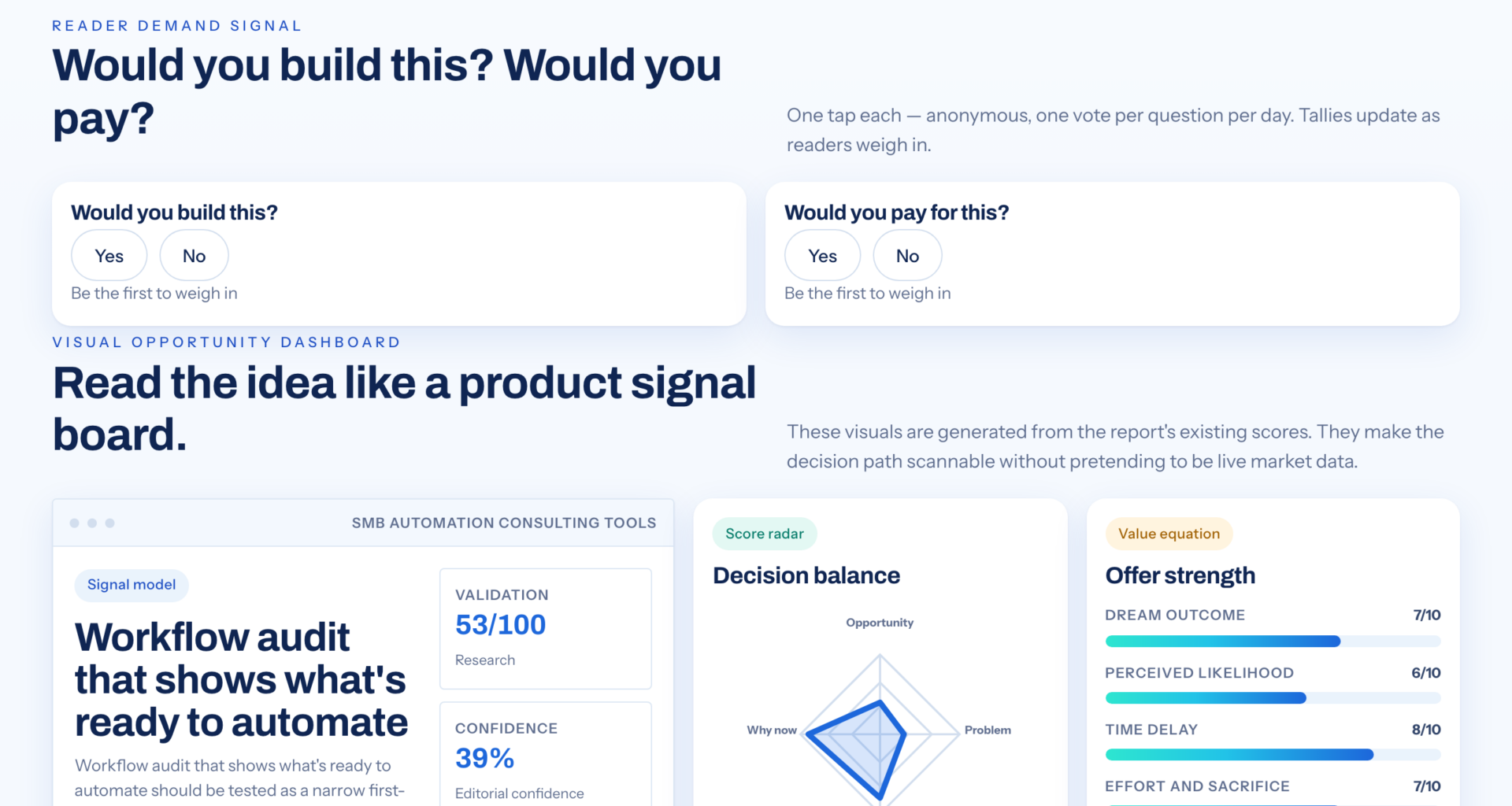

📊 Full opportunity report: Use These Workflow Questions To Assess Automation Readiness on IdeaNavigator AI — validation score, market gap, and execution plan.

Get business pricing on office and shipping supplies
- Business-only prices and quantity discounts
- Tax-exempt purchasing
- Multiple users, one account, clear invoices
TL;DR

IdeaNavigator AI has outlined a proposed workflow-audit product for small-business owners who are unsure which processes to automate. The concept would map operations, score potential projects and suggest tools, but its demand, implementation results and referral economics remain unproven.
IdeaNavigator AI has proposed a paid workflow audit to help small-business owners identify which operations may be suitable for automation, with a plan to test the concept by selling 50 audits and tracking implementation over 90 days. The proposal, published on IdeaNavigator AI’s website, describes a product idea and a validation plan; it does not report a launched service, completed sales or measured results.
According to IdeaNavigator AI’s proposal, the audit would guide an owner through questions about how the business operates, then produce a process map with each workflow scored for automation readiness, potential return on investment and difficulty, similar to approaches in AI workflow automation guides. The proposal also says the service would recommend a sequence of projects over a 90-day period and suggest tools for different business needs for each step. It identifies no specific software products, pricing or implementation partners.
IdeaNavigator AI describes the intended customer as a small-business owner who has heard about AI but cannot tell where it fits in their own operations, a challenge explored in examples of small businesses using AI automation software. The proposal frames the problem as a lack of visibility into existing processes: owners may delay action or purchase tools that do not fit their needs. These are the proposal’s stated assumptions, not findings supported by customer research or published data in the document.
The business model outlined by IdeaNavigator AI combines a paid audit with possible referral revenue from recommended software and implementation partners. The proposed test is to sell 50 audits, record which roadmap recommendations are implemented within 90 days, and examine referral-partner conversion economics. The proposal provides no audit price, target conversion rate or definition of a successful implementation.
Small Business · Proposed Product
Use These Workflow Questions To Assess Automation Readiness
IdeaNavigator AI proposes a guided workflow audit to help owners map operations, assess automation opportunities and plan next steps. The product and its results remain unproven.
The concept starts with understanding the work before choosing software.
IdeaNavigator AI has outlined a workflow-audit concept, not a launched service. The proposed test would sell 50 audits, track whether customers implement roadmap recommendations over 90 days, and examine referral economics. Demand, outcomes and commercial terms have not been reported.
Start with the work, then consider automation
The offer is aimed at owners who are interested in AI but unsure where it fits in their own operations.
The proposal describes a paid, guided audit that would ask how a business operates and turn those answers into a process map. Each workflow would be assessed for automation readiness, potential return on investment and difficulty.
The service would then sequence potential projects across a 90-day roadmap and suggest tools for different needs. No specific products, implementation partners or delivery model are named.
Three questions shape the proposed assessment
These dimensions are part of the concept; the proposal does not explain how scores would be calculated.
Can this workflow be automated?
Identify repeatable work and the process details needed to judge whether automation could fit.
Would the effort be worthwhile?
Estimate potential ROI against the expected value, costs and constraints of a project.
What would implementation take?
Consider complexity and practical obstacles before placing an idea on the roadmap.
From business interview to staged roadmap
The concept connects process discovery to tool recommendations and possible implementation support.
Ask
Gather how the business operates.
Map
Describe workflows and handoffs.
Score
Assess readiness, ROI and difficulty.
Sequence
Arrange projects over 90 days.
Suggest
Recommend tools and partners.
A proposed workflow design · No tested automated interview or recommendation process is reported
Evidence and product details are still missing
These gaps affect whether the offer can be judged, delivered consistently and trusted by customers.
How are readiness, ROI and difficulty defined and calculated?
What business information is collected, and how is it protected?
What are the price, turnaround time and staffing model?
How are referral relationships disclosed and recommendations ranked?
The proposed 50-audit test
The plan is designed to examine willingness to pay, customer action and referral economics over a 90-day window.
Tracking implementation is more informative than measuring interest alone: it could show which roadmap recommendations customers act on. Referral conversion data could also indicate whether partnerships generate revenue.
Even if completed, 50 sales would be an early test of this specific offer. Without a comparison group, baseline or success threshold, results would need careful interpretation.
- Sell: target 50 paid audits.
- Follow: track roadmap recommendations for 90 days.
- Measure: record implementation and referral-partner conversions.
- Define: set success criteria, pricing and implementation rules before interpreting results.
What readers should know
A concise guide to the proposal’s current status and claims.
What is the proposed workflow audit?
A paid service that would interview an owner, map processes, score automation projects and suggest a sequenced roadmap with tool recommendations.
Has it launched or been tested?
IdeaNavigator AI reports no launch, completed pilot or customer results. The proposal sets out a validation plan, with no start date.
How might it make money?
The proposed model combines payment for the audit with possible referral revenue from software and implementation partners. Pricing and terms are unspecified.
How does the proposal test demand?
Sell 50 audits, track recommendations implemented within 90 days and measure referral conversions. No success thresholds or results are provided.
Testing Demand for Practical Automation Advice
The proposal addresses a decision problem that can arise before a business buys automation software: owners need to identify and describe the work they want to improve. A structured audit could give them a way to compare tasks instead of selecting tools first. Whether it actually does so depends on the quality of the interview, the relevance of its scores and whether the recommendations account for each business’s constraints.
The plan’s 90-day implementation tracking is more informative than measuring interest in an audit alone. It could show whether customers act on the recommendations, while referral data could indicate whether tool partnerships generate revenue. But results from 50 sales would represent an early test of this particular offer, not proof that the approach works across small businesses generally.
The proposed model also creates a potential tension for customers: a service that earns referrals from recommended tools may have a financial incentive to favor some products. The outline does not say how recommendations would be ranked, whether referral relationships would be disclosed, or whether customers could receive an audit without buying recommended software. Those details matter when assessing whether guidance is independent.
Products Worth Considering

HP Sprocket Photo Booth Machine Instant Color Photo Printer with 10.1 Touchscreen, LED Ring Light, 250+ Frames, 3×4 ZINK Paper, QR Code Shar

FLEXISPOT 42-Inch Electric Standing Desk Converter

FLEXISPOT 32-Inch Electric Standing Desk Converter with Keyboard Tray
As an affiliate, we earn on qualifying purchases.
From AI Interest to Process Mapping
IdeaNavigator AI positions the concept within small-business automation consulting, where advice can start with mapping existing processes rather than selecting an AI product. Its proposal says the rationale is that the proliferation of AI tools has left some owners unsure which tasks are suitable for automation. It suggests that guided interviews could be supported by large language models, but provides no evidence that an automated interview has been tested or describes how a human would review its recommendations.
The workflow described in the proposal is to gather information about operations, map processes, score possible automation projects and arrange them into a staged roadmap. Tool suggestions and potential implementation partners would then connect the plan to purchasing or execution. IdeaNavigator AI presents this as a proposed product design, not as a service already available to customers.
The distinction is important: the concept identifies a customer problem, a possible product and a way to test demand, but IdeaNavigator AI reports no customer interviews, pilot outcomes or financial figures. The available details therefore support describing it as an idea with a validation plan, not as an established solution or a demonstrated market opportunity.
Evidence and Product Details Still Missing
IdeaNavigator AI reports no launch or pilot results. Its proposal does not say whether any audits have been sold, how the proposed readiness and ROI scores would be calculated, or what information owners would need to provide. It also does not explain how the system would handle sensitive business data or check that its process maps and tool recommendations are accurate.
Commercial details remain open in the proposal as well. It states no price, delivery time, staffing model or account of how referral partners would be selected. The document does not specify whether referral revenue would affect recommendations or how the service would disclose those arrangements to customers.
The 50-audit target and 90-day tracking window are proposed validation measures, not completed tests. IdeaNavigator AI provides no comparison group, baseline or success threshold, so even future results would need careful interpretation. The proposal does not state when the product might launch or whether the concept will proceed after testing.
The Proposed 50-Audit Test
IdeaNavigator AI’s proposal identifies the next step as selling 50 audits, then following customers’ roadmap items for 90 days and measuring referral-partner conversions. The proposed test could provide early evidence about whether owners will pay for this kind of assessment, which recommendations they act on and whether the referral model produces revenue.
For the results to be interpretable, the service would need to define what counts as an implemented recommendation and how it will calculate readiness, ROI and difficulty. Details about pricing, customer selection, data handling and referral disclosure would also help readers judge the offer. IdeaNavigator AI provides no timetable for the test or further announcement.
Source: IdeaNavigator AI
Key Questions
What is the proposed workflow audit?
IdeaNavigator AI proposes a paid service that would interview a small-business owner about operations, map processes, score possible automation projects and suggest a sequenced roadmap with tool recommendations.
Has the audit launched or been tested?
IdeaNavigator AI reports no launch, completed pilot or customer results. Its proposal sets out a validation plan but does not say when testing will begin.
How would the concept make money?
IdeaNavigator AI proposes combining payment for the audit with referral revenue from recommended tools and implementation partners. Pricing and referral terms are not specified.
How does IdeaNavigator AI propose to test demand?
The proposal calls for selling 50 audits, tracking which recommendations customers implement within 90 days and measuring referral-partner conversion economics. It provides no success thresholds or results.
Source: IdeaNavigator AI