TL;DR
A November 26, 2026, report traces self-service from grocery store shelves to barcode scanning and modern checkout kiosks. It describes five ways the shift changes shopping, while citing mixed retailer decisions and employment figures that show the technology has not eliminated cashier jobs.
A report published November 26, 2026, examines how self-checkout and kiosks have changed shopping by shifting tasks such as selecting, scanning and paying from employees to customers. The account traces the change from a Memphis grocery store in 1916 to current retail systems, while pointing to a mixed picture: some retailers have reduced self-checkout use, and cashier jobs remain widespread in the United States.

Get business pricing on office and shipping supplies
- Business-only prices and quantity discounts
- Tax-exempt purchasing
- Multiple users, one account, clear invoices
The report identifies five changes to the customer experience: shoppers take goods from shelves themselves, scan items, handle some payment steps, encounter automated checks and increasingly choose between staffed and self-service lanes. These changes can make parts of a purchase more direct, but they also ask customers to do work that store employees once handled. The report does not quantify how much time customers save or how satisfaction varies by shopper or store.
The history begins with Piggly Wiggly, which opened in Memphis in 1916. The Tennessee Encyclopedia says customers selected goods from shelves instead of asking clerks to fetch them. Clarence Saunders filed a patent for a “self-serving store” that year. Barcode scanning came much later: GS1 says the first product scanned was a ten-pack of Juicy Fruit gum at a Marsh supermarket in Troy, Ohio, on June 26, 1974. In 1984, David R. Humble and two colleagues filed a patent for a system in which shoppers scanned items themselves.
The report cites 3.1 million U.S. cashier jobs in 2025, down from about 3.6 million in 2019, according to the Bureau of Labor Statistics. It says the agency projects a further 6% decline by 2035. Those figures show a change in employment over time; they do not establish that self-checkout alone caused the decline. Retailers have also made different choices: the report says Booths in England, Dollar General and Target pulled back on self-checkout between 2023 and 2024, citing service, losses and speed. It reports that self-checkout accounts for one in eighteen checkouts in German retail and that Japanese supermarkets commonly use full or hybrid systems.
5 Ways Self-Checkout Changes The Customer Experience
Self-service shifts parts of shopping and checkout from employees to customers. Its impact depends on the store format and the support available.
Five ways shopping changes
Customers take on steps once handled by store employees.
Shoppers choose products directly from shelves.
Customers scan purchases at checkout.
Some payment steps move to the shopper.
Automated prompts may require customer action or staff help.
Shoppers may pick self-service or staffed checkout.
Checkout has changed in stages
Retailers make different choices
Automation is not a universal measure of a better checkout experience.
- Booths, Dollar General and Target reduced self-checkout use between 2023 and 2024.
- Reported concerns included service, losses and speed.
- Japanese supermarkets use full and hybrid self-checkout systems.
- Hybrid lanes combine staff scanning with customer payment.
How Checkout Work Shifts to Shoppers
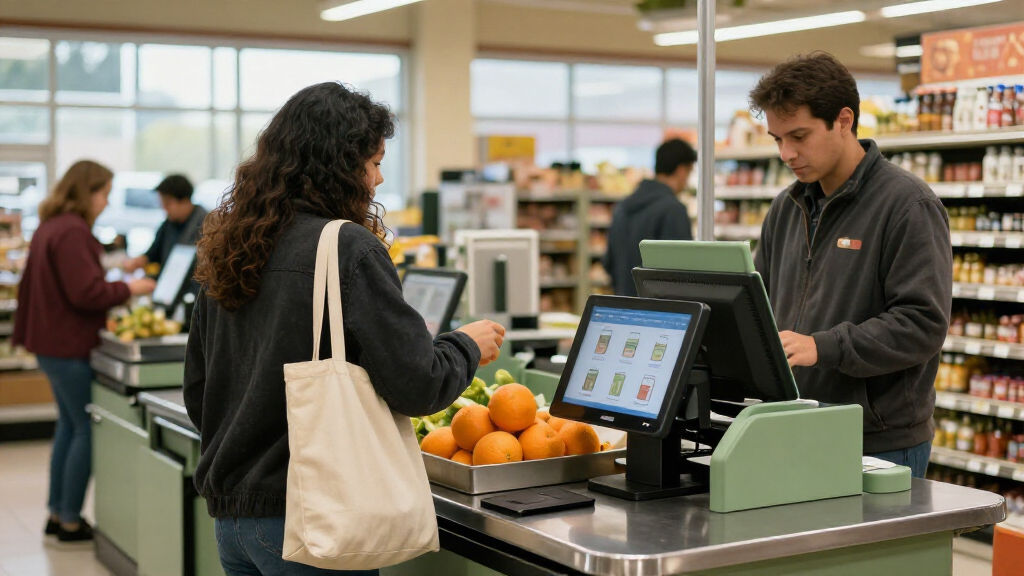
Self-service changes more than the equipment at the end of an aisle. It changes who performs the steps between choosing a product and leaving the store. Customers may scan and bag purchases, respond to prompts and seek help when a machine flags an item. That can give shoppers more control over the process, while making a smooth checkout depend partly on their comfort with the system and the availability of staff nearby.
For retailers, the trade-off reaches service, operating costs and loss prevention. The cited pullbacks show that some businesses have judged their self-checkout arrangements against concerns about speed, losses or customer service. The figures do not explain each retailer’s decision in detail, but they indicate that installing more machines is not a universal measure of a better customer experience. Stores continue to weigh automation against staffed assistance and hybrid options.
The employment figures add a longer-term consequence. Cashier employment declined between 2019 and 2025, and the Bureau of Labor Statistics projection points to a further decline by 2035. The report supplies no evidence isolating the effect of kiosks from other changes in retail, so the figures should be read as labor-market context rather than a direct measure of jobs replaced by machines.
Products Worth Considering

HP Smart Tank 7603 All-in-One Ink Tank Printer

LG 27U411A-B 27-Inch Full HD IPS Monitor, 120Hz, 1ms MBR, HDR10

HP LaserJet Pro 3105sdw Monochrome Laser Printer
As an affiliate, we earn on qualifying purchases.
From Grocery Shelves to Scanners
The report presents self-service as a gradual transfer of tasks. At Piggly Wiggly, shoppers took products from shelves while staff checked purchases and collected payment. The barcode made machine price-reading possible: GS1 places the first barcode scan at a Marsh supermarket in Ohio in 1974. A patent filed in 1984 described shoppers scanning goods themselves, with a scale checking item weight. The report notes that the early system still sent customers to a cashier to pay, illustrating that automation arrived in stages.
More recent examples include restaurant kiosks and different checkout formats. The report says nearly 17,000 McDonald’s restaurants had self-order kiosks by the end of 2018. It also reports that one in eighteen German retail checkouts is self-service, while half of Japanese supermarket companies use full self-checkout and more than eight in ten use a hybrid in which staff scan and customers pay. The figures come from the supplied source material; its excerpt does not provide the underlying study dates or methodology for the Germany and Japan comparisons.
““Instead shoppers selected from items placed on shelves within easy reach.””
— Tennessee Encyclopedia, describing Piggly Wiggly
What the Adoption Figures Cannot Show
The source does not provide survey results on whether customers prefer self-checkout, or comparable measurements of queue times, errors, losses and satisfaction before and after installation. It also does not specify the dates or methods behind its figures for Germany and Japan. The reported cashier totals and projection describe employment levels, but do not isolate the effect of checkout technology from other causes. The reasons cited for retailer pullbacks are summarized, without detailed company statements or store-by-store results.
Retailers Weigh Service and Automation
The next developments to watch are whether retailers expand, redesign or reduce self-service lanes, and whether hybrid systems become a more common way to balance customer choice with staff support. The Bureau of Labor Statistics projection cited in the report looks ahead to 2035, but it is a forecast rather than a settled outcome. Further evidence on customer satisfaction, checkout times and employment by store format would help establish which arrangements work best and for whom.
Key Questions
What are five ways self-checkout changes shopping?
It asks customers to select goods from shelves, scan items, complete some payment steps, respond to automated checks and choose between self-service and staffed checkout options.
When was the first barcode product scanned?
GS1 identifies a ten-pack of Juicy Fruit gum scanned at a Marsh supermarket in Troy, Ohio, on June 26, 1974, as the first product scanned with a barcode.
Have self-checkout machines replaced cashier jobs?
The report cites 3.1 million U.S. cashier jobs in 2025, down from about 3.6 million in 2019, and a Bureau of Labor Statistics projection of a further 6% decline by 2035. Those figures do not show how much of the change is caused by self-checkout.
Are all retailers expanding self-checkout?
No. The report says Booths, Dollar General and Target pulled back between 2023 and 2024, citing service, losses and speed. Other markets in the report show continued use of full and hybrid self-service systems.
Source: Thorsten Meyer AI