

📊 Full opportunity report: How To Navigate Pesticide-Residue Regulations In International Food Trade on IdeaNavigator AI — validation score, market gap, and execution plan.

Get business pricing on office and shipping supplies
- Business-only prices and quantity discounts
- Tax-exempt purchasing
- Multiple users, one account, clear invoices
TL;DR
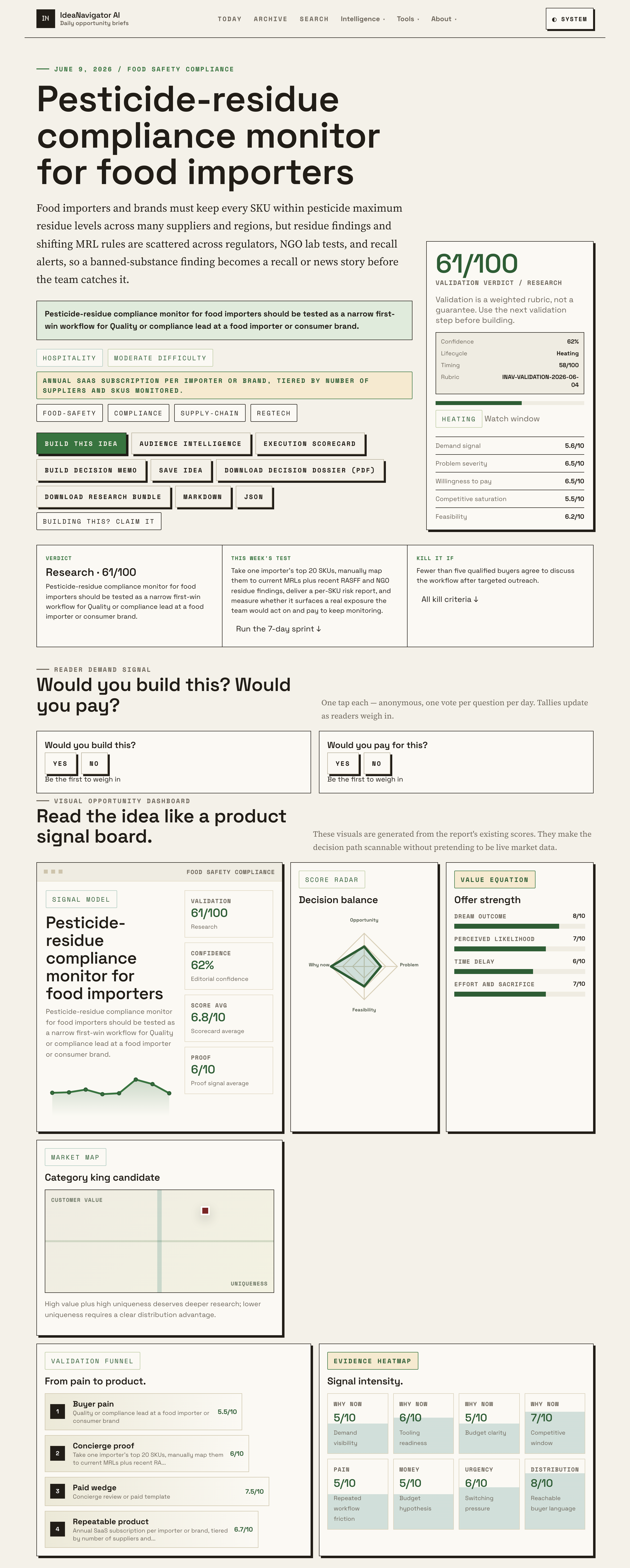
A proposed pesticide-residue compliance monitoring tool aims to help food importers track and manage residue levels across multiple regions. This development addresses increasing regulatory complexity and NGO testing findings. Its effectiveness and adoption are still under validation.
A new pesticide-residue compliance monitoring tool is being developed to assist food importers and brands in managing pesticide residue levels across multiple regions. This initiative responds to increasing regulatory demands, NGO testing findings, and retailer requirements, aiming to reduce the risk of product recalls and non-compliance issues.
The proposed compliance monitor is designed to map a brand’s suppliers and SKUs against current EU and regional maximum residue levels (MRLs), as well as recent public residue findings from sources such as RASFF alerts and NGO tests. It will flag products at risk of non-compliance and generate audit-ready reports for each SKU, streamlining the compliance process for importers.
According to ideas from industry sources, the monitor would be offered as a SaaS subscription, with tiered pricing based on the number of suppliers and SKUs monitored. The goal is to validate its effectiveness by testing it on an importer’s top 20 SKUs, comparing the tool’s risk assessments with actual residue findings, and evaluating whether it can prevent potential breaches before they occur.
Current challenges include the scattered nature of residue data, the tightening of MRLs across markets, and the frequent surfacing of banned pesticides in staples like rice, tea, and spices. These factors contribute to the risk of product recalls, reputational damage, and regulatory penalties for importers and brands.
Implications for Food Importers and Global Trade
This development could significantly impact how food importers manage compliance, potentially reducing the incidence of recalls and regulatory violations. As residue findings and MRL rules evolve rapidly, having a real-time, mapped view of risks can help companies proactively address issues, maintain market access, and meet retailer demands for documented compliance.
However, the effectiveness of such a tool depends on its ability to accurately integrate diverse data sources and provide timely alerts. Its adoption may also influence regulatory practices and testing standards in international food trade.
As an affiliate, we earn on qualifying purchases.
Growing Regulatory Pressure and NGO Testing Findings
In recent years, NGO testing organizations and regulators have increasingly identified EU-banned pesticides in staple foods such as rice, tea, and spices. These findings have led to heightened scrutiny, recalls, and calls for stricter MRL enforcement across markets. Retailers and importers face mounting pressure to demonstrate compliance, often without centralized data or efficient monitoring systems.
Current efforts rely heavily on manual mapping of SKUs to MRLs and scattered testing results, which are time-consuming and prone to oversight. The proposed monitor aims to address these gaps by providing a comprehensive, automated view of residue risks.
“Effective mapping of residues and regulations is crucial as MRLs tighten and NGO findings surface more frequently.”
— an anonymous researcher
As an affiliate, we earn on qualifying purchases.
Effectiveness and Adoption of the Compliance Monitor
It is not yet clear how accurately the proposed monitor will integrate diverse data sources, or how quickly companies will adopt it. Validation is ongoing, and real-world effectiveness remains to be proven through pilot testing and user feedback.
regulatory compliance food testing
As an affiliate, we earn on qualifying purchases.
As an affiliate, we earn on qualifying purchases.
Pilot Testing and Validation of the Compliance Tool
The next step involves testing the monitor on an importer’s top 20 SKUs, comparing its risk assessments with actual residue findings, and evaluating whether it can effectively prevent non-compliance. Industry partners and developers aim to refine the tool based on these results before broader rollout.
importer pesticide residue report tool
As an affiliate, we earn on qualifying purchases.
As an affiliate, we earn on qualifying purchases.
Key Questions
How will the compliance monitor help importers avoid recalls?
The monitor will flag products at risk of exceeding pesticide residue limits based on current data, allowing importers to address issues proactively before products reach the market.
What data sources will the monitor use?
It will integrate EU and regional MRL databases, recent RASFF alerts, NGO testing reports, and other publicly available residue findings.
Is this compliance tool available now?
It is currently in development and undergoing pilot testing; wider availability depends on validation results and industry adoption.
Will the monitor cover all regions and pesticides?
Initially, it will focus on key markets like the EU and major trading regions, with plans to expand coverage as data sources and regulations evolve.
Source: IdeaNavigator AI
Fall Picks
fall essentials
As an affiliate, we earn on qualifying purchases.