
TL;DR

Get business pricing on office and shipping supplies
- Business-only prices and quantity discounts
- Tax-exempt purchasing
- Multiple users, one account, clear invoices
Phone-camera technology now allows consumers to objectively measure tooth shade at home, improving the accuracy of teeth whitening efforts. An app prototype can score and track shade changes over time, offering personalized product recommendations. This innovation aims to reduce guesswork and enhance consumer confidence in dental aesthetics.
Phone-camera technology is emerging as a tool to objectively measure tooth shade at home, offering a new way for consumers to track whitening progress. This development could significantly improve the accuracy and confidence of DIY dental aesthetics, addressing a long-standing challenge in the home whitening market.
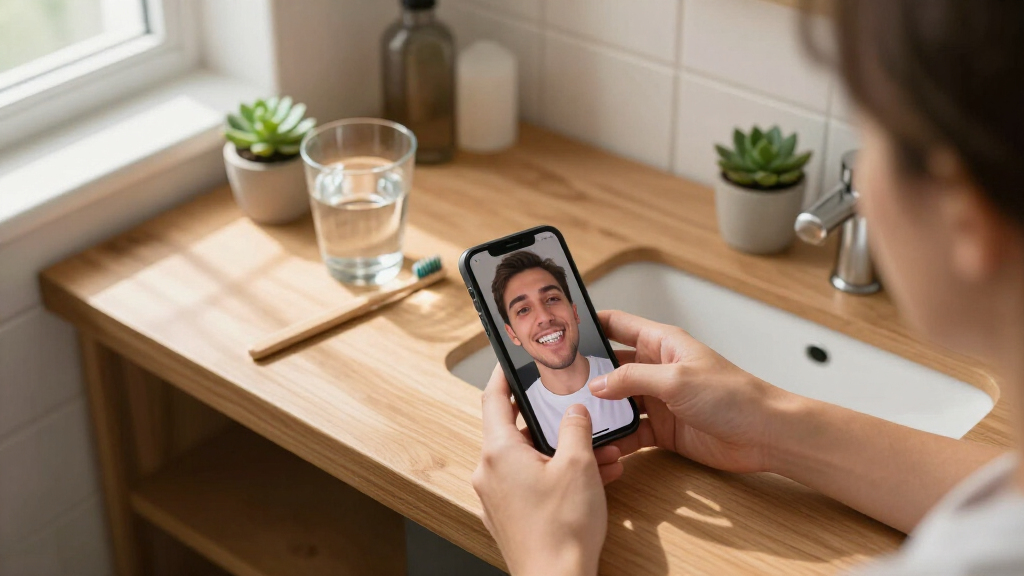
Recent advancements in smartphone camera capabilities, combined with guided-lighting and calibrated imaging, are enabling consumers to obtain more precise measurements of their tooth color without visiting a dentist. An innovative app prototype has been designed to score tooth shade against a standardized dental shade scale, such as VITA, and track changes over weeks.
The app works by guiding users through a photo capture process with controlled lighting, then analyzing the image to assign a shade score. These scores can be plotted over time, showing how whitening products like strips, trays, or LED kits are affecting tooth color. The app also offers product recommendations based on data from users with similar starting shades, aiming to personalize and optimize whitening routines.
According to IdeaNavigator AI, the core validation involves benchmarking the app’s shade scores against dentist-assessed VITA readings for about fifty users. Early testing suggests a strong correlation, which could support the app’s use as an objective measurement tool in consumer settings. Revenue models include subscriptions and affiliate commissions on proven whitening products.
Transforming Home Whitening with Objective Measurements
This innovation addresses a key challenge in the consumer dental care market: the lack of objective, reliable tools for measuring teeth whitening progress at home. Currently, most users rely on subjective visual assessments in bathroom mirrors, which can be inaccurate and inconsistent. By providing a calibrated, easy-to-use measurement method, the technology could improve consumer confidence, reduce product churn, and foster more effective whitening routines.
Furthermore, this development could shift the market dynamics by introducing a measurement layer that enhances product transparency and efficacy. Brands that integrate such technology may gain a competitive edge, offering personalized results and data-driven advice. Overall, this could lead to better aesthetic outcomes for consumers and a more scientifically grounded approach to DIY dental care.
As an affiliate, we earn on qualifying purchases.
Advances in Smartphone Tech Enable Better Dental Measurements
The idea of using phone cameras for dental shade assessment is not entirely new, but recent improvements in camera quality, guided-lighting, and image processing algorithms have made it feasible to approximate professional dental shade readings at home. The concept gained momentum as the global market for consumer oral care and beauty tech continues to grow, with consumers seeking more personalized and measurable solutions.
Historically, at-home whitening success has depended heavily on subjective judgment and trial-and-error. Dentists have long used calibrated shade guides like VITA to assess tooth color, but these tools are not practical for everyday consumer use. The new approach aims to bridge this gap by translating professional methods into a smartphone app, validated through clinical benchmarking.
Early prototypes have shown promising results, with correlation levels approaching those of professional assessments. The market’s interest is driven by the increasing demand for at-home aesthetic treatments and the desire for objective, quantifiable results that can be easily tracked over time.
“Advances in guided-lighting and image analysis are making it possible for consumers to get near-professional accuracy in tooth shade measurement at home.”
— an anonymous researcher
smartphone tooth shade measurement app
As an affiliate, we earn on qualifying purchases.
As an affiliate, we earn on qualifying purchases.
Validation and Adoption Challenges for Consumer-Grade Devices
While early testing shows promising correlation with dentist assessments, the app’s accuracy across diverse lighting conditions, skin tones, and tooth types remains to be fully validated. Larger clinical trials are needed to confirm reliability and consistency. Additionally, regulatory considerations and consumer acceptance are still evolving, and it is unclear how quickly these tools will be adopted at scale.
As an affiliate, we earn on qualifying purchases.
Next Steps: Clinical Validation and Market Launch Plans
Developers plan to conduct broader validation studies comparing app scores with professional dental readings, aiming to refine the algorithm for greater accuracy. Concurrently, they will work on integrating user feedback to improve usability and lighting guidance. If successful, a pilot launch is expected within the next year, with potential commercial availability following subsequent testing and regulatory review.
As an affiliate, we earn on qualifying purchases.
Key Questions
How accurate are phone cameras at measuring tooth shade?
Current prototypes show a strong correlation with professional dental shade assessments, but accuracy can vary depending on lighting and device quality. Validation studies are ongoing to confirm reliability.
Will this technology replace dental visits for shade assessment?
No, it is intended as a supplementary tool for home use, providing objective measurements to complement professional evaluations.
Can this app help improve whitening results?
Yes, by tracking shade changes objectively, users can better understand which products and routines are effective, leading to more personalized and effective whitening efforts.
Is this technology available now?
Currently, prototypes are in testing phases, with plans for broader validation and eventual market launch within the next year.
What are the potential limitations of this technology?
Limitations include variability in lighting conditions, device differences, and the need for extensive validation to ensure consistent accuracy across diverse users.
Source: IdeaNavigator AI
Evergreen bestsellers Picks
bestsellers
As an affiliate, we earn on qualifying purchases.