
🔍 Read the full analysis: Why IBM’s CEO Is Betting On Companies Running AI Themselves on ThorstenMeyerAI.com

Get business pricing on office and shipping supplies
- Business-only prices and quantity discounts
- Tax-exempt purchasing
- Multiple users, one account, clear invoices
TL;DR
IBM CEO Arvind Krishna is urging enterprises to consider open-weight AI models running on their own infrastructure, saying they can approach frontier-model performance at much lower token costs. Independent benchmark data supports a narrowing performance gap, but the strongest downloadable model in the cited comparison scores 80% of the proprietary leader, not 90%; on-prem economics also depend on utilization, staffing and licensing.
IBM CEO Arvind Krishna is making the case for enterprises to run open-weight AI models on their own infrastructure, saying on the company’s October 21 earnings call that they can cost a fraction of frontier models while being “90% as effective.” Independent benchmark figures cited by ThorstenMeyerAI.com show the best model with downloadable weights at 80% of the leading proprietary model as of October 26, while the cost advantage of running systems in-house depends on equipment use and operating expenses.
Krishna said open-weight models can cost 25% to 10% of the token cost of frontier models. He framed the trade-off as choosing a model that is “10% of the cost” and “90% as good as the best,” rather than paying ten times as much. His examples included routine tasks such as summarizing email, reviewing contracts and answering customer calls. These are Krishna’s estimates and examples, not a universal performance or price comparison.
The independent Artificial Analysis Intelligence Index comparison reported by ThorstenMeyerAI.com puts MiMo-V2.6-Pro at 46.3, the highest score among models with downloadable weights in the October 26 snapshot. The leading proprietary model, Claude Opus 5.5, scored 57.6, making MiMo’s score about 80% of the leader. The report says the comparable open-to-proprietary ratio was 51% at the end of 2024 and 74% at the end of 2025. The index scores are benchmark results, not a direct measure of performance on every company’s workloads.
A possible exception is Kimi K3.1 Pro, which scored 55.1 in the same index, or 96% of Claude Opus 5.5. But the source says its developer, Moonshot, had promised to release the weights “by Nov 4”; until those weights are made available, the model does not count as open-weight in this comparison. The report also notes that a model’s licence terms matter: downloadable weights do not automatically mean unrestricted commercial use.
IBM's 90% claim, checked
Open weights reach 80% of the leader
Krishna says open-weight models are "90% as effective". On an independent index the best model you can download today reaches 80% of the best closed one, up from about half two years ago.
Best open model as a share of the best closed
Artificial Analysis Intelligence Index, current version, best downloadable vs. best proprietary model at each date.
What Krishna said
Illustrations from the earnings call, not a named benchmark.
- Late 2024"70" vs. "20 or 30"Krishna, Q3 call, 21 Oct · no named benchmark
- Late 2025"70 to 50"Krishna, Q3 call, 21 Oct · no named benchmark
- Now"90% as effective"Krishna, Q3 call, 21 Oct · no named benchmark
Top downloadable models today
Intelligence Index score and licence type. Read the licence before the leaderboard.
| Model | Index | Licence |
|---|---|---|
| MiMo-V2.6-Pro Xiaomi | 46.3 | MIT |
| DeepSeek V4.1 Flash 1017 DeepSeek | 45.1 | MIT |
| GLM-5.3 Z AI | 44.8 | own commercial licence |
| Step 5 Preview StepFun | 43.7 | own commercial licence |
| Muse Spark Open Meta | 38.9 | licence with conditions |
In points the gap did not shrink: 7.5 points at the end of 2024, 11.3 today. Closed models moved too.
Sources: Artificial Analysis, Intelligence Index v4.3.2 (read 26 Oct 2026), IBM Q3 2026 earnings call transcript (21 Oct 2026), Artificial Analysis on Kimi K3.1 Pro (23 Oct 2026).
Powered by Thorsten Meyer AI
The Economics of Running AI In-House
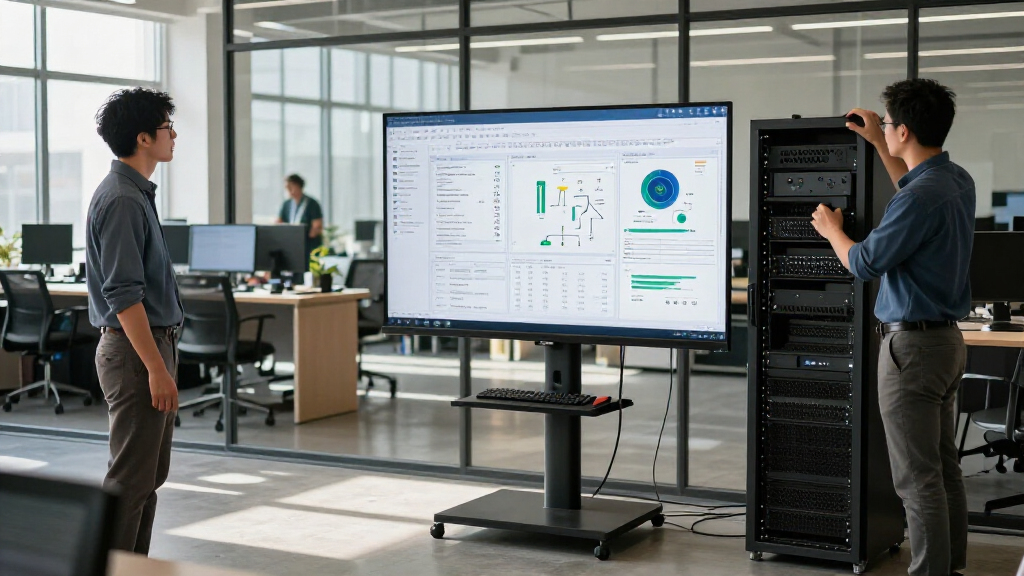
Krishna’s pitch matters because enterprises face a choice between buying AI access as a service and investing in infrastructure they operate themselves. Running models in-house may offer more control over data and logs, a concern Krishna highlighted for banks and trading firms. He said open-weight models give customers permission and intellectual-property rights to run them on premises or in private clouds; the practical scope of those rights depends on each model’s licence.
The financial case is not simply a comparison of token prices. The source gives a list price of $172,643 for an eight-GPU H200 server and a rental price of $63.30 an hour for the same GPU class on AWS. Its calculation estimates that buying could match rental costs after about 114 days at full utilization, but about 15 months at 25% utilization. Those estimates exclude staff, cooling and networking, and rely on the cited list prices and assumptions. Low utilization or added operating costs can change the result.
There is also an organizational cost. Krishna acknowledged that many companies lack the kernel engineering and networking expertise needed to operate complex AI systems, describing the frontier cloud as the easier option despite its higher cost. That makes the decision a question of total operating capability, not just model access or hardware prices.
Products Worth Considering

Samsung 27-inch Odyssey OLED G6 QD-OLED QHD Gaming Monitor

Apple iPad Air (2025) 13‑inch Wi‑Fi 256 GB – Space Gray (M3 chip)

Apple iPad Air 13-inch (M4), 128GB, Wi-Fi 7, Space Gray
As an affiliate, we earn on qualifying purchases.
What Krishna Said on the Call
The cost and performance comparison came during the question-and-answer portion of IBM’s Q3 earnings call, rather than the prepared remarks, according to the source report. Krishna described the relative performance of open and leading models as improving over time, using examples of benchmark scores in late 2024 and late 2025 before making his 90% claim. The source says those figures were illustrations rather than results from a named benchmark.
IBM has a commercial interest in on-premise AI: it sells infrastructure and expects demand to support sales of its Spyre accelerator cards. That does not invalidate Krishna’s argument, but it is relevant when weighing the company’s cost claims. IBM also said in prepared remarks that its llm-d project helps run large models at five to ten times lower cost; the source report says it could not independently verify that figure. It further cites The Register’s report that IBM’s mainframe revenue fell 20% in the quarter, which may add business context to the company’s interest in infrastructure demand.
Costs, Licences and Model Access
The cited price and benchmark figures do not establish what a particular company would save. Actual economics depend on workload, utilization, power, cooling, networking, staffing and the terms of hardware and cloud contracts. The comparison also does not show that open-weight models perform equally well on every task or that their token prices translate directly into lower total operating costs.
Several details remain unsettled in the source material. Kimi K3.1 Pro’s weights had not shipped as of the report’s October 26 check, and the source says no licence had been published. IBM’s claim about llm-d’s cost reduction is also unverified there. Model licences vary, and some downloadable models carry commercial or use conditions. The source further reports that NVIDIA had not commented on the GeForce firmware issue described in its article; that matter is separate from IBM’s enterprise pitch and does not establish a general route to lower data-centre costs.
The Tests Enterprises Still Need
The next practical test is whether open-weight models deliver adequate results on companies’ own tasks at a lower total cost of ownership. That requires pilots that include hardware utilization, engineering time, data controls and licence review—not just benchmark scores or per-token prices. Enterprises weighing on-premise systems against cloud services will also need to determine whether they have the staff to maintain and optimize the infrastructure.
On the model side, the comparison may change if Moonshot releases Kimi K3.1 Pro’s weights and publishes licence terms, as promised in the source report. New model releases can also move both sides of the benchmark comparison. IBM’s cost statements and its llm-d claim remain company claims unless independently tested against clearly specified workloads and operating assumptions.
Key Questions
What is IBM CEO Arvind Krishna proposing?
Krishna is encouraging enterprises to consider open-weight AI models that can be run on their own servers or private clouds, rather than relying only on proprietary models accessed through cloud services.
Do the cited benchmarks confirm that open models are 90% as good?
No. In the October 26 comparison cited by ThorstenMeyerAI.com, the strongest model with downloadable weights scored about 80% of the proprietary leader. Kimi K3.1 Pro scored about 96%, but its weights had not yet been released according to the report.
Are open-weight models always cheaper to run?
No. Lower token prices do not by themselves establish lower overall costs. Buying and operating servers involves hardware, utilization, power, cooling, networking and staff; the economics depend on a company’s workload and capacity use.
Why might a company run AI on its own infrastructure?
Some organizations may want greater control over sensitive data and logs, or may find that in-house operation suits their needs. Krishna cited data sovereignty as a reason for interest among banks and trading firms, while also acknowledging that technical staffing can be a barrier.
What remains to be verified?
The real-world savings for specific workloads remain uncertain, as do the independent results behind IBM’s llm-d cost claim. The availability and licensing of some models, including Kimi K3.1 Pro in the source report, also require confirmation.
Source: ThorstenMeyerAI.com