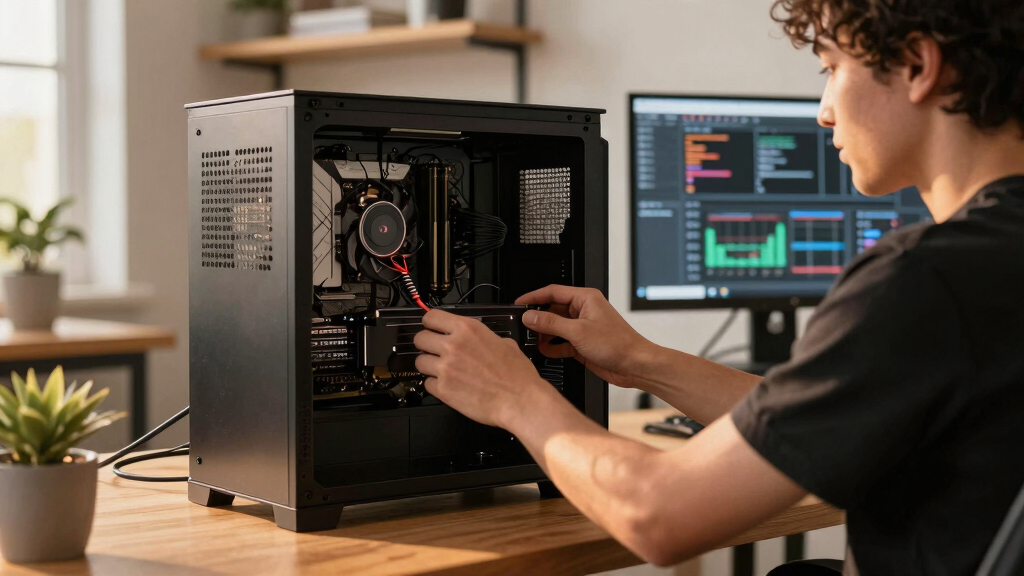

📊 Full opportunity report: Undervolting Your GPU for Local Inference: Lower Heat, Same Tokens/sec on ThorstenMeyerAI.com — validation score, market gap, and execution plan.

Get business pricing on office and shipping supplies
- Business-only prices and quantity discounts
- Tax-exempt purchasing
- Multiple users, one account, clear invoices
TL;DR
Undervolting GPUs through power limiting reduces heat and noise during AI inference, maintaining nearly the same tokens/sec. This approach is simple, reversible, and highly effective for inference workloads.
Recent experiments confirm that undervolting GPUs via power limiting during local AI inference can substantially lower heat output and noise without sacrificing tokens per second, making it a practical optimization for AI workstations.
Multiple sources, including recent technical guides, show that reducing the power limit on modern GPUs like the NVIDIA RTX 4090 and RTX 5090 results in a significant decrease in temperature and fan noise while maintaining nearly full inference performance. The key insight is that most local inference workloads are memory-bandwidth-bound, so lowering core voltage and clock speeds does not meaningfully impact tokens/sec.
One developer’s measurements indicate that lowering power to around 70% of maximum reduces power consumption by approximately 25%, cuts temperatures by 5-10°C, and only slightly reduces tokens/sec—by less than 7%. This is backed by data showing that a power cap between 50-55% offers the best efficiency, with minimal speed loss, especially in inference tasks.
The recommended method is using power limiting tools such as MSI Afterburner, which allows users to set a maximum power percentage. This method is reversible, safe, and does not require extensive testing, making it suitable for most users. More advanced undervolting, which involves editing voltage-frequency curves, can squeeze out further efficiency but is more complex and not necessary for typical inference workloads.
Undervolt for inference:
lower heat, same tokens/sec.
Local inference is memory-bound — the GPU core spends much of its time waiting on VRAM, not maxing out compute. So when you cap its power, heat falls fast while throughput barely moves. Drag the slider in Part 2 to see the trade for yourself.
(the real limit)
(often waiting)
you pay for in heat
| Power limit | Power draw | Temp | Speed kept | Efficiency |
|---|---|---|---|---|
| 100% (stock) | 390 W | 72°C | 100% | baseline |
| 80% | 330 W | 70°C | 98.6% | +17% |
| 70%recommended | 300 W | 67°C | 93.4% | +22% |
| 60% | 260 W | 62°C | 91.5% | +37% |
| 55%peak efficiency | 240 W | 60°C | 89.2% | +45% |
| 50% | 220 W | 58°C | 82.6% | +46% |
| 40% (too far) | 180 W | 52°C | 61.3% | falls off |
- One slider, 100% → 70%. The card reduces voltage and clocks on its own.
- Can’t damage anything — you’re restricting the card, not pushing it.
- No stability testing needed.
- Captures most of the available benefit.
- Edit the voltage-frequency curve — hold a clock at lower voltage.
- Target around 0.9–0.95V to start; better chips go lower.
- Keeps more performance for the same heat cut.
- Test under your real workload — a curve stable for 10 min can fail on hour 3.
MSI Afterburner (works on any brand). Headless Linux: nvidia-smi or LACT.sudo nvidia-smi -pl 300.Impact of Power Limiting on AI Inference Efficiency
This development is significant because it demonstrates a simple, effective way to optimize AI inference setups by reducing heat and noise without sacrificing performance. For users running high-power GPUs continuously, this can lead to quieter operation, lower energy costs, and less thermal stress, extending hardware lifespan. It also makes high-performance inference more accessible in less ventilated or quieter environments.
GPU undervolting software MSI Afterburner
As an affiliate, we earn on qualifying purchases.
As an affiliate, we earn on qualifying purchases.
GPU Factory Settings and Inference Bottlenecks
Modern GPUs like NVIDIA's RTX series are factory-tuned for peak benchmark scores, with conservative voltage curves to ensure stability across all units. Most local inference workloads are memory-bandwidth-bound rather than compute-bound, meaning the GPU core does not need to run at maximum clocks to achieve high tokens/sec. Previous guides focused on gaming, where lowering core clocks can impact frame rates, but inference workloads tolerate aggressive power caps with minimal speed loss.
Recent tests and user reports confirm that capping power at around 60-80% of maximum yields significant thermal and acoustic benefits, with less than 10% performance reduction. This approach aligns with the fact that the GPU's core is often not the limiting factor during inference, unlike gaming or rendering tasks.
"Lowering the power limit on modern GPUs during inference can dramatically reduce heat and noise without meaningful performance loss."
— Thorsten Meyer, AI hardware expert
NVIDIA RTX 4090 power limit adjustment
As an affiliate, we earn on qualifying purchases.
As an affiliate, we earn on qualifying purchases.
Remaining Questions About Long-Term Stability
While initial data is promising, it is still unclear how sustained undervolting or power limiting affects hardware longevity over months or years. Additionally, the optimal settings may vary between GPU models and workloads, and some users report occasional instability when pushing limits too far. More long-term testing is needed to confirm these effects.
GPU temperature monitor for inference
As an affiliate, we earn on qualifying purchases.
As an affiliate, we earn on qualifying purchases.
Next Steps for GPU Power Optimization in AI Workstations
Users are encouraged to experiment with power limiting tools like MSI Afterburner to find their optimal balance of heat, noise, and performance. Hardware manufacturers may also incorporate more granular power management features in future GPU drivers. Researchers and enthusiasts will likely continue testing undervolting and power caps across different models and workloads to refine best practices.
GPU noise reduction cooling solutions
As an affiliate, we earn on qualifying purchases.
As an affiliate, we earn on qualifying purchases.
Key Questions
Does undervolting affect training or only inference?
Undervolting primarily benefits inference workloads, which are memory-bandwidth-bound. Training, being more compute-bound, may experience more noticeable performance impacts if undervolted too aggressively.
Can I undo undervolting or power limiting if I experience issues?
Yes, both methods are reversible. You can restore default settings via your GPU utility or BIOS, and no hardware damage occurs from adjusting these parameters.
Is undervolting safe for all GPUs?
Most modern GPUs are designed to handle power adjustments safely, especially when using software like MSI Afterburner. However, aggressive undervolting may cause instability in some units, so gradual adjustments and testing are recommended.
How much performance do I lose when undervolting at recommended levels?
At optimal power caps around 50-60%, performance loss is typically less than 10%, which is often imperceptible during inference tasks.
Source: ThorstenMeyerAI.com
Halloween Picks
halloween
As an affiliate, we earn on qualifying purchases.