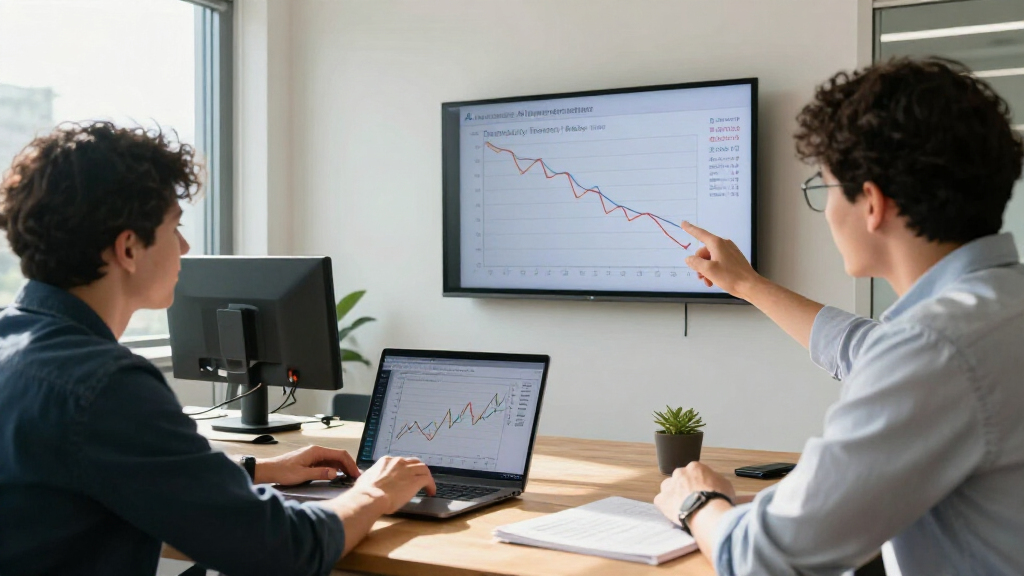

🔍 Read the full analysis: How Could A Cooler AI Market Affect Economic Growth? on ThorstenMeyerAI.com

Get business pricing on office and shipping supplies
- Business-only prices and quantity discounts
- Tax-exempt purchasing
- Multiple users, one account, clear invoices
TL;DR
The U.S. economy grew at a 3.4% annual rate in the third quarter of 2026, and BEA data show computers and software contributed 1.09 percentage points. That does not mean AI alone drove growth: consumer spending led, imported equipment reduced measured GDP, and the figures are an advance estimate. A pullback could hit technology suppliers, construction and power projects, though lower imports would also reduce one subtraction from GDP.
The U.S. economy grew at a 3.4% annual rate from July through September 2026, while purchases of computers and software made a substantial contribution to output, according to the Bureau of Economic Analysis. The figures arrive as technology-market commentary points to possible cracks in AI-related spending, but they do not establish that AI investment is about to fall or that it alone is driving growth.
The BEA’s advance estimate, released October 29, put real gross domestic product growth above the 3% forecast in a FactSet survey cited by the Associated Press. The 3.4% figure is an annualized pace; the economy’s actual expansion during the quarter was 0.8%. Consumer spending was the largest contributor, adding 2.52 percentage points, as households spent more on health care, restaurants and hotels, and prescription drugs.
Business spending on computers and peripheral equipment rose at a 66.7% annual rate and contributed 0.72 percentage points to GDP growth. Adding other information-processing equipment and software brings the contribution to 1.09 points, or about 32% of the quarter’s growth, based on the source’s calculations from BEA tables. The government does not report a separate AI investment category, so these lines are proxies, not a direct measure of spending on AI.
Imports complicate the picture. GDP counts domestic production and subtracts imports; imports rose at a 19.7% annual rate, with capital goods among the largest contributors. The source estimates imported computer equipment reduced growth by about 1.1 percentage points, but this is an author calculation rather than a BEA estimate of AI’s net impact. Meanwhile, Census Bureau data put private data-center construction at an $85 billion annual rate in August, up 73% from a year earlier.
Infographic 01 · US GDP, July to September 2026
Where the 3.4% came from
Consumers carried most of the growth. Equipment, software and a big inventory build added the rest, and a surge in imports took a large slice back.
Contributions to growth, in percentage points
Each bar is one kind of spending. Bars right of the line added to growth, bars left of it subtracted. Together they make the 3.4%.
- Consumer spendinghealth care, restaurants and hotels, medicines+2.52
- Equipmentof which computers and peripherals +0.72+1.16
- Software and researchintellectual property; software alone +0.23+0.47
- Business buildingsstructures+0.15
- Housingresidential investment−0.12
- Inventoriescompanies stocking up+1.61
- Governmentmostly federal+0.90
- Exportsled by petroleum products−0.68
- Importssubtracted in GDP; led by capital goods−2.64
Sum: +3.4% (details do not add exactly because of rounding)
Advance estimate, the first of three; the second follows on 25 November 2026. “Annual rate” means the quarterly pace extended to a full year.
Sources: BEA, GDP advance estimate Q3 2026, 29 Oct, Table 1.5.2 (contributions, expanded detail) · AP, 29 Oct (consensus).
Powered by Thorsten Meyer AI
Where an AI Pullback Could Land
A slower pace of technology investment could weigh on growth through fewer orders for servers, chips, software and data-center construction. The effects would not be evenly spread: contractors, equipment suppliers, power projects and lenders tied to data-center development may face more exposure than the economy as a whole. The source reports data-center construction rising even as factory construction fell 20% year over year in August, illustrating how concentrated some building activity may be.
The headline GDP effect is not a simple subtraction of computer purchases. If U.S. businesses buy fewer servers made abroad, imports could also decline, reducing the amount subtracted from GDP. The net effect depends on how much spending falls, whether purchases are domestic or imported, and what replaces them. A market slowdown could also affect companies and households through share prices, particularly people with savings invested in stocks, but the source does not quantify that exposure.
Employment is another point of uncertainty. Employers added 29,000 jobs in September, below the reported prior-year monthly average of 45,000. The source says hiring linked to the boom is visible in specialty trades at non-residential construction sites, but the figures do not show how many jobs are specifically attributable to AI facilities.
Products Worth Considering

Logitech MX Mechanical Wireless Illuminated Performance Keyboard – Clicky

Brother QL-800 High-Speed Professional Thermal Label Printer
Apple iMac 2024 All-in-One Desktop with M4 Chip, 24‑inch Retina Display, 16GB Unified Memory, 256GB SSD, Silver
As an affiliate, we earn on qualifying purchases.
What the GDP Figures Measure
The BEA measures GDP as the value of goods and services produced in the United States. Its quarterly growth rate is commonly presented at an annual rate, so the reported 3.4% describes what the pace would look like if it continued for a full year; it is not a claim that output rose 3.4% in three months. Contribution figures express how different spending categories added to or subtracted from the overall growth rate.
There is no official AI line in the GDP accounts. Computer equipment and software can support AI systems but are also used for other purposes. Likewise, the construction data identify data centers as a fast-growing type of facility, not the share of that construction devoted to AI. The source’s estimate that computers and software supplied roughly 45% of growth over the last four quarters is its arithmetic using BEA tables, not a government attribution to AI.
The report also includes large contributions from inventories and government spending, alongside consumer spending and fixed investment. The advance estimate is the first of three and relies partly on assumptions where September data were not yet available. It may change as fuller information arrives.
“Information processing equipment and software added 1.09 points of the 3.4 points of growth.”
— Thorsten Meyer, citing BEA Table 1.5.2
How Much Spending Is AI-Driven?
The available figures do not reveal exactly how much computer, software or data-center spending is for AI rather than other business needs. Nor do they show whether the reported market concerns will lead companies to cancel or delay projects. The source notes that the Nasdaq fell 2.9% on Friday after the GDP release, but a one-day market move does not establish the cause of the decline or prove a change in investment plans.
The GDP number itself is provisional. The BEA’s first estimate uses some assumptions because September data were incomplete, and the import-related estimate is the source author’s calculation. The scale and timing of any future pullback, its effect on domestic suppliers, and the resulting employment impact remain unknown.
The November GDP Revision
The BEA is scheduled to publish its second estimate on November 25, incorporating additional data that may revise third-quarter growth and its components. That release should clarify whether the initial readings on investment, inventories, imports and consumer demand hold up.
For signs of a genuine cooling in AI-related activity, investors and policymakers will need to watch subsequent company investment plans, computer-equipment orders, data-center construction and related hiring. The source material does not identify a confirmed set of project cancellations or a forecast for the next quarter, so the direction and size of any slowdown remain open.
Key Questions
Did AI account for 32% of U.S. economic growth in the third quarter?
No official figure says that. The source calculates that computers, other information-processing equipment and software contributed 1.09 percentage points of the 3.4% annualized growth rate. Those categories are proxies and include spending that may not be related to AI.
Why are imports subtracted from GDP?
GDP measures production within the United States, so goods produced abroad are not counted as U.S. output. Imports are subtracted from spending totals to remove those foreign-produced goods. If server imports fall, that subtraction may also shrink.
Has AI investment already started to decline?
The supplied figures do not confirm a decline. They show strong third-quarter computer spending and rising data-center construction, alongside market commentary warning of possible cracks in the spending boom. Whether companies reduce planned investment is not yet clear.
When will the GDP estimate be updated?
The BEA’s second estimate is scheduled for November 25, 2026. It may revise the initial growth rate and category-level contributions as more data become available.
Source: ThorstenMeyerAI.com