📊 Full opportunity report: Learning To Negotiate IEPs: Simulator-Based Rehearsal For Parents on IdeaNavigator AI — validation score, market gap, and execution plan.

Get business pricing on office and shipping supplies
- Business-only prices and quantity discounts
- Tax-exempt purchasing
- Multiple users, one account, clear invoices
TL;DR
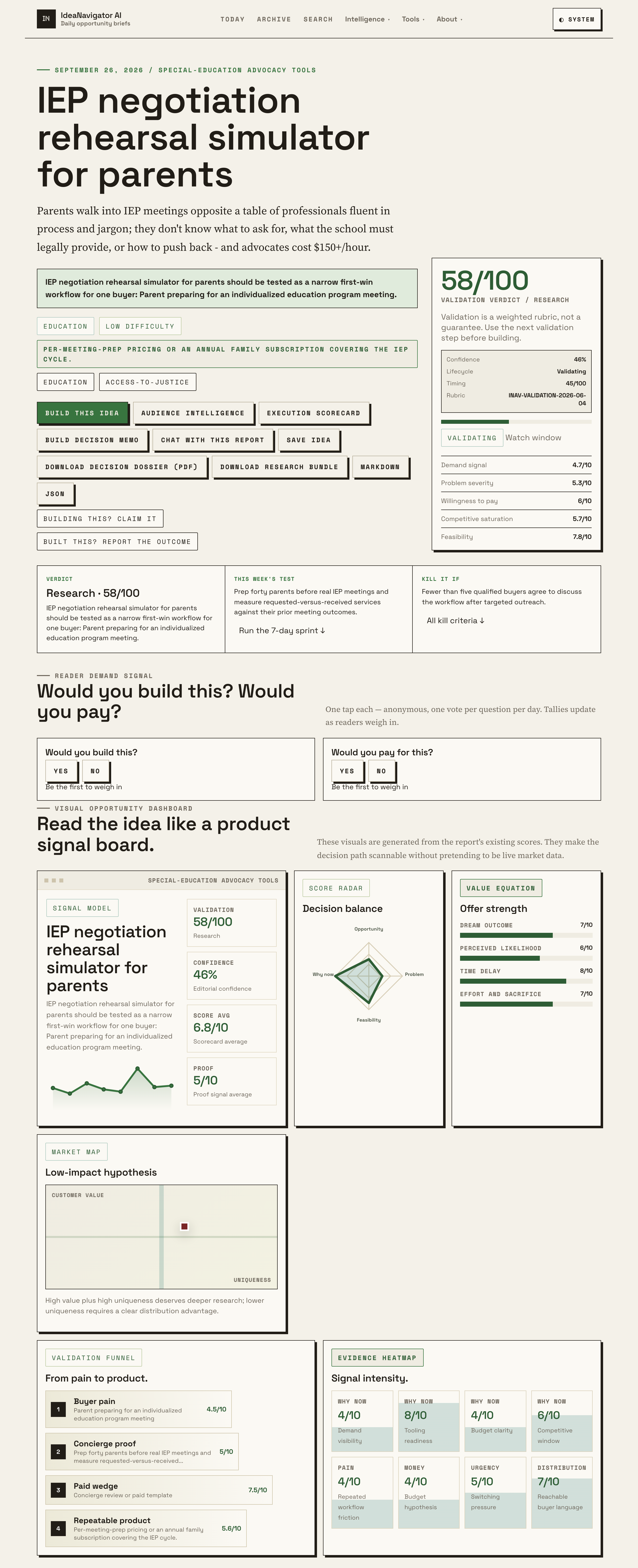
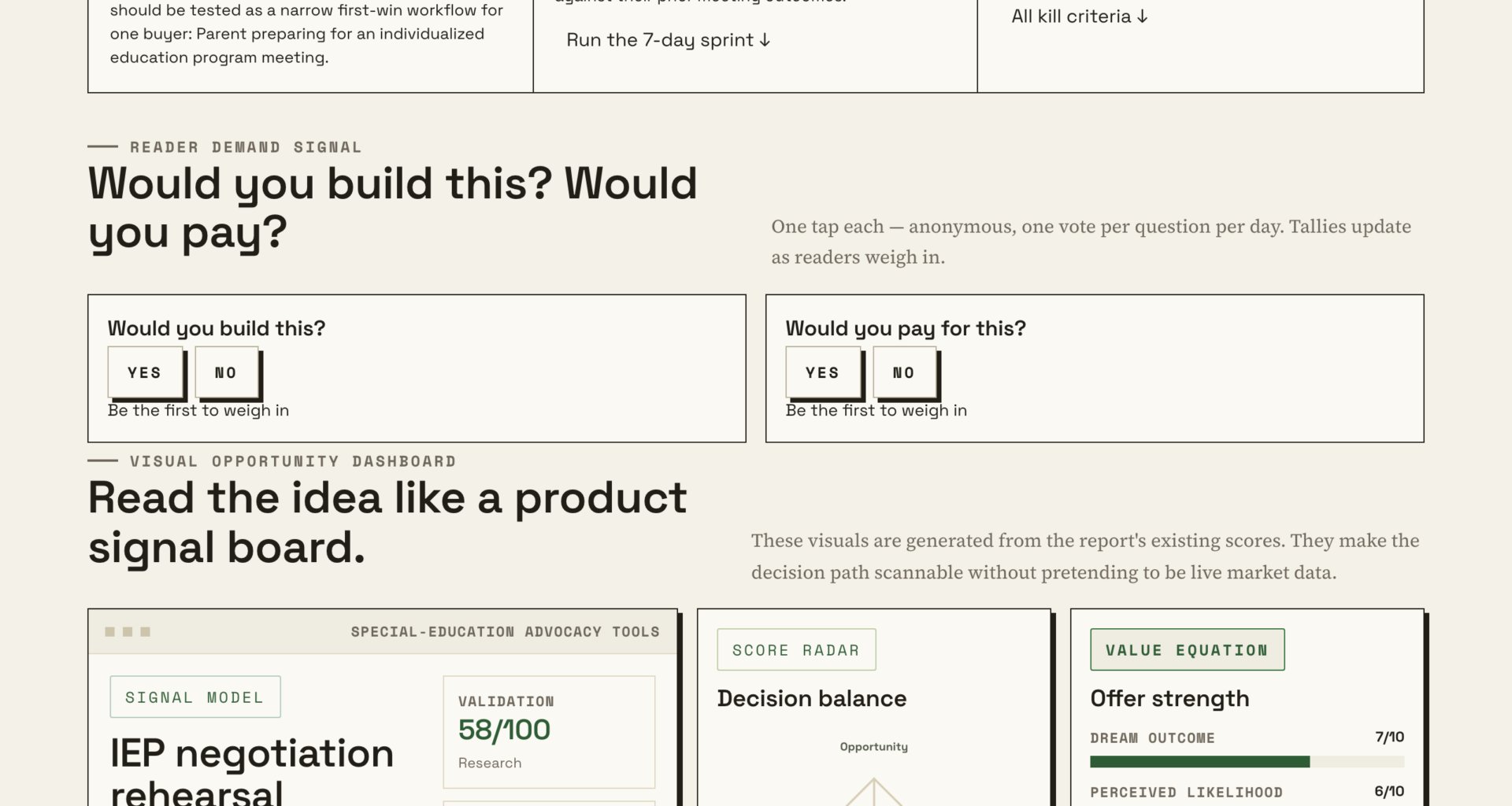
IdeaNavigator AI has published a product proposal for an IEP negotiation rehearsal simulator that would let parents upload their child’s education plan and role-play meetings with AI-generated pushback before the real session. The proposal includes a per-meeting or subscription pricing model and a validation test with forty parents. No such product is confirmed to exist yet.
A new product proposal from IdeaNavigator AI calls for building an IEP negotiation rehearsal simulator that would let parents practice individualized education program meetings against a realistic, AI-driven counterpart before sitting down with their school district. The proposal, framed as a narrowly scoped “first-win” tool for a single type of buyer — a parent preparing for an IEP meeting — includes a minimum product design, a pricing model, and a concrete plan to test whether rehearsal improves outcomes. No working product or published validation results exist yet.
The proposal identifies a specific asymmetry: parents typically walk into IEP meetings facing a table of school professionals who are fluent in the process and its jargon, while the parent may not know what to ask for, what the school is legally required to provide, or how to push back when requests are declined. Professional advocates who can fill that gap often charge $150 or more per hour, according to the proposal, putting sustained expert help out of reach for many families.
The minimum viable product, as described, would work in three stages. A parent would first upload the current IEP and evaluation reports. The tool would then explain the child’s entitlements in plain language and generate a request list with legal grounding for each item. Finally, it would role-play the meeting itself — including realistic resistance from the school-side simulation — repeating until the parent can hold their positions under pressure.
The proposal names two possible revenue models: per-meeting-prep pricing or an annual family subscription covering the full IEP cycle. The target market is described as special-education advocacy tools. Timing, the proposal argues, is driven by two converging trends: large language model role-play has become good enough to simulate a credible IEP meeting, and rising special-education identification rates combined with tightening district resources are making the meetings more adversarial.
Why Families May Want Rehearsal
IEP meetings determine the services, accommodations, and placement a child with a disability will receive for the school year, and the outcome depends heavily on how effectively a family can articulate and defend requests. If a rehearsal tool worked as described, it could shift some of that negotiating capability from paid professionals to parents themselves — particularly families who cannot afford advocate fees that the proposal pegs at $150 or more per hour.
The proposal is also a specific instance of a broader shift: AI role-play systems are moving from general-purpose chat toward narrow, high-stakes preparation tasks such as contract negotiation, medical appointments, and, in this case, due-process-heavy education meetings. The stakes here are legally grounded — the request list the tool would generate is meant to be tied to education law, not general persuasion tactics — which is why the proposal frames it as preparation rather than legal advice.
The Pressure Behind IEP Meetings
An individualized education program is the legally binding plan schools in the United States must develop for each student eligible for special-education services under the Individuals with Disabilities Education Act. Meetings to draft or revise the plan typically include teachers, specialists, and administrators, while parents attend as equal legal participants — a status that can be hard to exercise without fluency in the terminology and process.
According to the IdeaNavigator AI analysis, two conditions make the idea timely. First, special-education identification rates keep climbing while district resources tighten, a combination the analysis says is producing more adversarial meetings. Second, current language-model role-play capability has reached the point where a simulated meeting — including pushback — is realistic enough to be useful practice rather than a toy.
What Is Untested So Far
The entire concept exists as a proposal, not a shipped or independently evaluated product. Key open questions include:
- Whether simulated meetings accurately reflect how real school teams respond, including the range of pushback parents actually encounter.
- Whether the tool’s plain-language explanations of entitlements are legally accurate in every state and district context — the proposal provides no review process for this.
- Whether requested-versus-received services is a fair measure of the tool’s effect, since meeting outcomes also depend on district resources and the child’s changing needs.
- Whether parents facing time and cognitive strain would adopt a rehearsal tool at the proposed price points.
No results from the forty-parent validation test have been reported, and it is not clear whether the test has begun.
The Forty-Parent Validation Test
According to the proposal, the next step is to build the minimum version — upload, entitlement explanation, request-list generation, and role-play — and then prep forty parents ahead of real IEP meetings. Success would be measured by comparing requested-versus-received services against each family’s own prior meeting outcomes, providing a before-and-after baseline per participant rather than a cross-group comparison. Whether anyone pursues this build and test remains to be seen; no developer, funding, or launch timeline has been announced.
Source: IdeaNavigator AI
Key Questions
Is this IEP simulator an available product?
No. It is a product proposal from IdeaNavigator AI. No working version, launch date, or company behind a build has been announced.
How would the simulator work?
A parent would upload the current IEP and evaluation reports; the tool would explain entitlements in plain language, generate a legally grounded request list, and role-play the meeting with realistic pushback until the parent can hold their positions.
How would anyone know it actually helps?
The proposal’s validation plan is to prepare forty parents before real meetings and compare requested-versus-received services against their own prior meeting outcomes. No results have been reported.
What would it cost?
The proposal suggests either per-meeting-prep pricing or an annual family subscription covering the IEP cycle. No specific prices have been set.
Does the tool replace a special-education advocate or lawyer?
The proposal positions it as preparation, not professional representation. Professional advocates often charge $150 or more per hour, according to the proposal, and no claim is made that the simulator substitutes for legal advice.
Source: IdeaNavigator AI
Halloween Picks
halloween
As an affiliate, we earn on qualifying purchases.