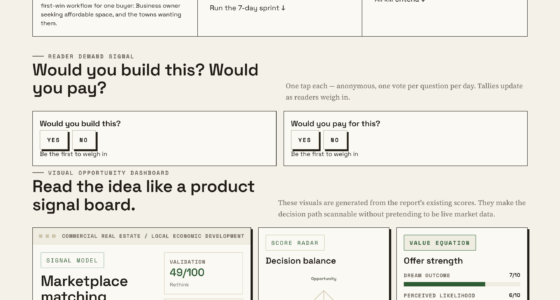
📊 Full opportunity report: Bring Agency Social Media Tasks And Workflows Together on IdeaNavigator AI — validation score, market gap, and execution plan.

Get business pricing on office and shipping supplies
- Business-only prices and quantity discounts
- Tax-exempt purchasing
- Multiple users, one account, clear invoices
TL;DR

IdeaNavigator AI has outlined a product concept for creator teams and small social agencies: manage each post as a task from brief through approval and scheduling. The proposal recommends testing the idea with 10 agencies and comparing missed publishing windows and approval turnaround with their current setup; no test results or product launch are reported.
IdeaNavigator AI has proposed a task-based social media workspace for creator teams and small agencies managing content across clients, with each post tracked from brief to publication. The proposal is a product concept, not a reported launch: it recommends migrating 10 agencies from their existing two-tool workflows and measuring missed publishing windows and approval turnaround.
The proposed workspace would organize work around individual posts as tasks, rather than relying mainly on a publishing calendar. Each task would move through stages such as brief, asset, edit, approval and scheduled, keeping the work and its status connected as a post moves toward publication.
Proposed features include client-facing approval links, asset versioning and native scheduling once a post is approved. The intended workflow would connect an idea to a published post in one pipeline. These are features in the proposal; there is no confirmation that a working product exists or that the features have been built.
The suggested business model is a per-seat subscription, with client-seat pricing for agencies. To test demand and performance, the proposal calls for moving 10 agencies from their current two-tool setups and comparing missed-window rates and approval turnaround against each agency’s baseline. No results, participating agencies or pilot schedule are provided.
Testing the Workflow Gap
The concept addresses a coordination problem for teams that manage content across several clients. A post may require a brief, creative assets, editing, client approval and scheduling; when those steps sit in separate tools, teams can have difficulty tracking status, finding the current asset version or identifying who must act next. The proposal argues that task management and publishing are often split between a social scheduling tool and a general project-management tool.
If validated, a single post-focused workflow could reduce the need to reconcile updates across those systems. For agencies, clearer approval stages and client access could make handoffs easier to monitor. But the practical value remains a testable hypothesis: the proposal does not provide evidence that the approach reduces missed deadlines, shortens approvals or outperforms existing tools.
The proposed pilot’s measures are relevant to that question. Comparing missed publishing windows and approval times with a baseline could show whether the workflow changes day-to-day operations. Those findings would also help establish whether agencies see enough value to pay per seat and whether separate client-seat pricing fits their needs.
Products Worth Considering

Brother TD-2020A 2‑Inch Direct Thermal Desktop Label Printer with USB

Apple iPad Air 13-inch (M4), 128GB, Wi-Fi 7, Space Gray

Apple iPad Air (2025) 13‑inch Wi‑Fi 256 GB – Space Gray (M3 chip)
As an affiliate, we earn on qualifying purchases.
From Calendar to Post Tasks
The proposal frames the product around a mismatch between how social work is performed and how many teams organize it. Work is described as a sequence of assignments—shoot, edit, approve and schedule—while social management products are characterized as organized around calendars and posts. In this account, teams bridge the gap by combining a publishing product with a general task-management tool.
That description is the rationale behind the idea, not independently established market research. The proposal identifies creators and small social agencies coordinating multiple clients as the initial audience, rather than claiming the product is suited to every social media team. It also says rising content expectations have increased workflow demands, but gives no figures or time series to quantify that change.
The recommended approach is deliberately narrow: first test one buyer group and one recurring workflow, then assess whether the combined task and publishing pipeline performs better than the tools agencies already use. The proposed validation plan does not specify how agencies would be selected or how long the comparison would run.
Pilot Results Are Not Available
No product launch, completed pilot or agency participation is reported. The proposal does not name a developer, give a release date, identify a price or confirm that the listed features are in development. It also provides no baseline data showing how often teams miss publishing windows or how long client approvals currently take.
The proposed comparison would need to clarify how missed windows and approval turnaround are defined, what period is measured and whether agency workflows are comparable. Without those details and results, it is not possible to determine whether the concept would improve performance, attract paying customers or fit into existing social media systems.
A Ten-Agency Test Is Proposed
The next step described in the proposal is a 10-agency validation test. Agencies would move from their current two-tool arrangements to the proposed workflow, with missed publishing windows and approval turnaround compared against their own baselines. The proposal gives no start date or operating details, so it remains unclear whether or when the test will take place.
If a pilot proceeds, its results could help establish whether the task-based setup addresses a real coordination issue and whether agencies would adopt the suggested per-seat model. Until implementation and findings are reported, the idea remains a proposed product direction rather than a verified improvement in social media operations.
Source: IdeaNavigator AI
Key Questions
Has the task-based social media workspace launched?
No launch is reported. The details describe a product concept and proposed features, not a confirmed, available product.
Who is the proposed workspace for?
The initial audience is creator teams and small social agencies coordinating content across clients.
What would the workspace include?
The proposal describes post tasks that move through brief, asset, editing, approval and scheduling stages, along with client approval links, asset versioning and scheduling after approval.
How would the idea be tested?
IdeaNavigator AI proposes moving 10 agencies from two-tool workflows and comparing missed publishing windows and approval turnaround with each agency’s baseline. No test results are available.
What remains unknown about the proposal?
There is no reported developer, launch date, price, pilot schedule or participating agency list. The proposal also gives no measured evidence that the workflow improves publishing or approval outcomes.
Source: IdeaNavigator AI