

🔍 Read the full analysis: Build A Better Workday With These 12 AI Productivity Apps on ThorstenMeyerAI.com

Get business pricing on office and shipping supplies
- Business-only prices and quantity discounts
- Tax-exempt purchasing
- Multiple users, one account, clear invoices
TL;DR
ThorstenMeyerAI.com has published a roundup of 12 AI productivity apps and learning resources for tasks including writing, meeting notes and workflow building. It names a Google Gemini Workspace guide as its leading workflow-oriented pick, while stressing that the best choice depends on the user’s task and that the list includes books and a directory, not only software.
ThorstenMeyerAI.com has published a roundup of 12 AI productivity apps and resources for work such as drafting, meeting capture and workflow planning. The site identifies a Google Gemini Workspace guide as its top workflow-oriented pick, but says the right choice depends on the task; the list also mixes software with books and a directory.
The roundup presents Google Gemini AI Workspace as its leading option for readers who want to connect AI assistance with practical workflows in Google Workspace. According to the source, its emphasis is on building a personal system rather than using AI only as a standalone chat feature. The article does not provide comparative performance tests or evidence that it is best for every user.
For narrower needs, the source highlights Conference Notes App for meeting capture and AI Writer Pro for drafting. It also distinguishes AI Writer Pro, which is described as supporting text production, from SmartPrompt, which is presented as a way to improve the instructions used to generate text. Readers exploring note-taking options can also consider AI-powered note apps. The supplied material does not spell out detailed feature lists for every product.
The 12-item selection includes more than working applications. An automation directory and handbooks about Gemini and Microsoft 365 are learning resources: they can help readers explore or plan workflows, but do not perform tasks in the way software does. The source says its rankings reflect defined use cases, workflow breadth, practical direction, setup demands and possible overlap with tools people already use. For additional workflow ideas, see other AI productivity tools.
The 12 picks
- 1
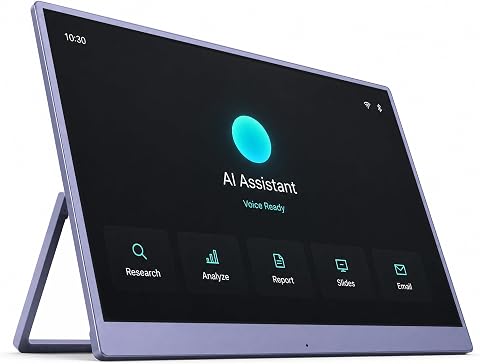 VAIMI AI Companion Hub with 15.6-Inch DisplayView on Amazon →
- 2
 The Complete Microsoft 365 and Copilot Handbook, Volume I: Core Apps and AI-E…View on Amazon →
- 3
 Aulax Smart AI Productivity, Writing, and Assistant AppView on Amazon →
- 4
 The Google Gemini AI Workspace: Build Smart AI Workflows, Automate Tasks, Cre…View on Amazon →
- 5
 The Complete Guide: The Ultimate Directory of 5,000+ Apps in 500+ Categories…View on Amazon →
- 6
 AI Writer Pro: Write SmartView on Amazon →
- 7
 SmartPrompt – AI Prompt Generator & EnhancerView on Amazon →
- 8
 AI NotebookView on Amazon →
- 9
 AIO AI ApexView on Amazon →
- 10
 GPT AI Chatbot: Chat, RPG Games, and AI AssistantView on Amazon →
- 11
 AI AssistantView on Amazon →
- 12
 Conference Notes AppView on Amazon →
Match Tools to Daily Work
The roundup’s practical point is that a broad assistant is not automatically the most useful choice. Someone who regularly turns meetings into records may benefit more from a focused meeting tool, while a frequent writer may prefer an application centered on drafting. A general-purpose product can offer flexibility, but may require users to establish prompts and routines before it fits into their day.
That distinction matters because productivity depends on the whole task, not just how quickly an AI system produces an initial response. Users still need to review results, correct errors and fit outputs into existing processes. The source advises testing a tool on a real, recurring task and weighing any time saved against setup, maintenance and correction.
The list also asks readers to distinguish learning material from working software. A guide may help someone design a process, but implementation remains their responsibility. That makes the roundup relevant to both people shopping for an app and those still deciding how AI might fit their work.
Products Worth Considering

Apple MacBook Pro MPHF3LL/A 14.2-Inch Laptop | M2 Pro 12-Core Chip 16GB Unified Memory 1TB SSD | 19-Core GPU Liquid Retina XDR Display Space

Dell XPS 13 9350 Copilot+ Laptop, 13.4-inch 120Hz Display, Intel Core Ultra 7 256V, 16GB RAM, 512GB SSD, Ubuntu Linux 24.04 LTS

Logitech MX Keys S Combo Wireless Keyboard and Mouse, Graphite
As an affiliate, we earn on qualifying purchases.
How the Picks Were Ranked
ThorstenMeyerAI.com says it ranked the items by how clearly they support a repeatable productivity task, how much practical guidance they give buyers and whether their scope matches the work they claim to help with. The article gives greater weight to defined uses such as meeting notes, writing and workflow building than to products whose names alone do not establish a clear role.
The source describes the order as a judgment about usefulness across common work needs, not a claim that one product suits everyone. It also says setup effort and overlap with existing software count as tradeoffs. Where the supplied product information is limited, the article says it avoids assuming capabilities based on a product’s name.
Its selection guidance recommends starting with one recurring task, checking whether information can move into and out of a tool, and reviewing data-handling terms before submitting sensitive material. For workplace or confidential information, it says users should follow their organization’s rules. It also recommends comparing tools on the same real task and checking the final output, including names, decisions and action items in meeting records.
“A broad assistant is not automatically the best fit.”
— ThorstenMeyerAI.com
Product Details Still Limited
The supplied source material does not identify all 12 entries by name or provide detailed descriptions of each one. It also gives no publication date, pricing, subscription terms, test results or quantified evidence of time saved. As a result, readers cannot use this information alone to compare costs, verify specific features or determine how the products perform against one another.
It is also unclear from the material how each product handles user data, what integrations are available, or whether capabilities vary by plan. Those details matter when tools may process meeting records, internal documents or drafts. The source advises checking providers’ data terms and organizational policies, but does not report product-specific privacy findings.
Test a Real Work Task
The source recommends choosing one frequent task and testing a candidate tool with the user’s own work, such as a draft, meeting record or recurring workflow. Readers can compare the finished, reviewed result with their existing process and account for setup, cleanup and ongoing upkeep, rather than judging only the first AI-generated output.
Before adopting a tool, users should check where their information goes, whether outputs can be retrieved or exported, and whether the product is an app or a learning resource. The supplied material does not announce a follow-up test or a date for further product updates, so the next practical step is a task-specific trial and verification of current product terms.
Key Questions
What is the roundup’s top AI productivity pick?
ThorstenMeyerAI.com names Google Gemini AI Workspace as its leading workflow-oriented choice. The source describes it as a guide to building a personal system with Google Workspace, not as a universal winner for every task.
Which picks are aimed at specific work tasks?
The source identifies Conference Notes App as a meeting-focused option and AI Writer Pro as a writing-focused choice. It presents SmartPrompt as helping improve instructions for generating text.
Are all 12 picks software apps?
No. The source says the selection also includes an automation directory and handbooks about Gemini and Microsoft 365. These resources can support learning and planning, but they are not substitutes for task-performing software.
How should someone decide which tool to try?
Start with a recurring task, then test the tool on real work. Compare the usable result with the existing process, including time spent correcting output, setting up workflows and maintaining them.
Does the roundup show that these apps save time?
The supplied material offers no measured time-saving results or comparative tests. It gives selection guidance and product recommendations, so individual users would need to test tools against their own tasks.
Source: ThorstenMeyerAI.com