📊 Full opportunity report: Can Better Property Discovery Bring Businesses To Small Towns? on IdeaNavigator AI — validation score, market gap, and execution plan.

Get office and shipping supplies delivered free — and shop member deals
- Fast, free delivery on millions of items
- Access to Prime Big Deal Days deals on October 6–7
- Prime Video, Amazon Music and more included
TL;DR
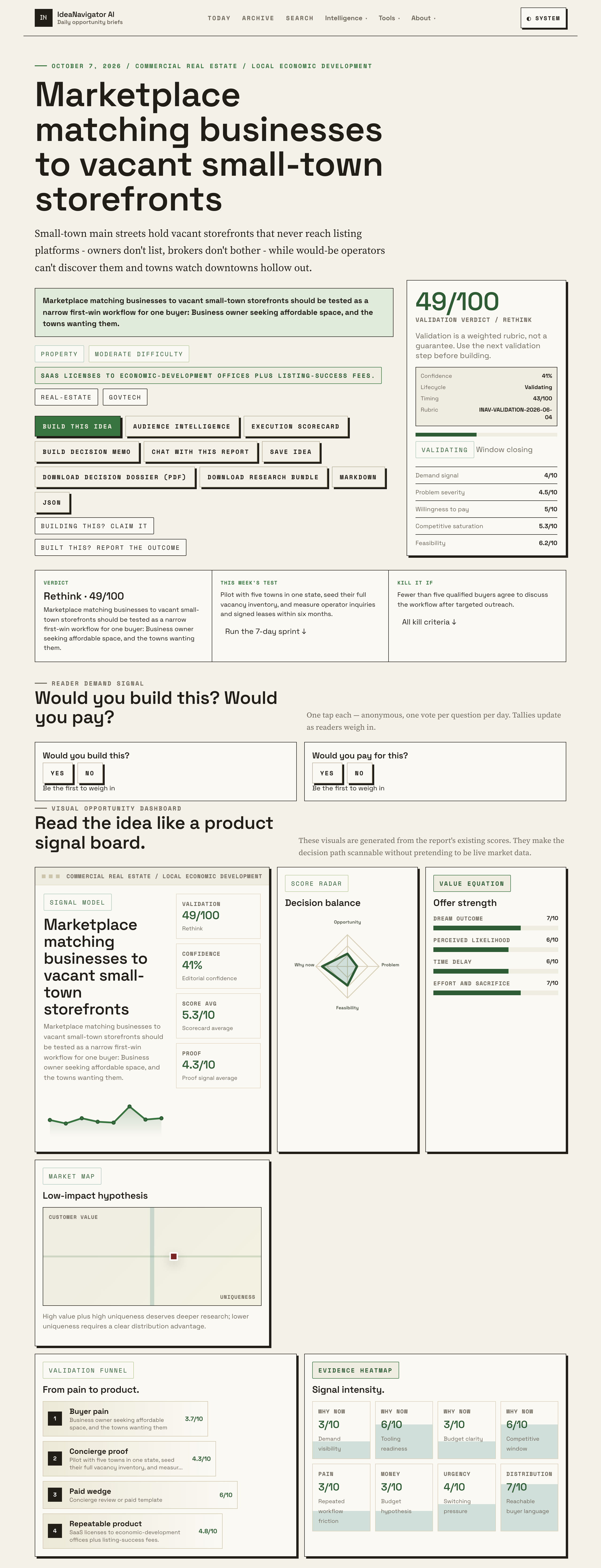
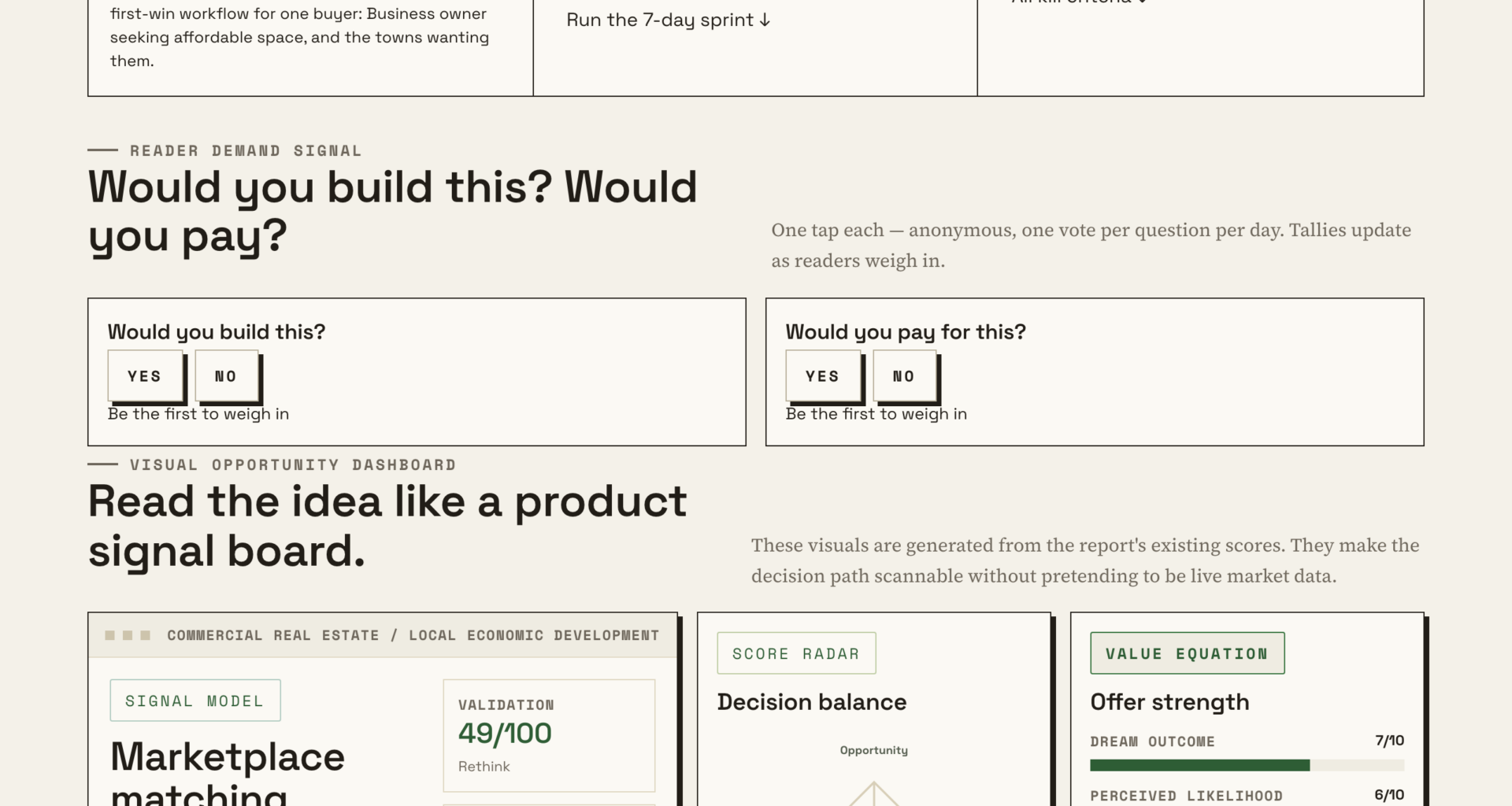
IdeaNavigator AI proposes testing a marketplace that connects businesses seeking affordable premises with vacant storefronts in small towns. The proposed pilot would cover five towns in one state and track operator inquiries and signed leases over six months; no pilot results or confirmed funding are provided.
IdeaNavigator AI has proposed a marketplace to connect business operators with vacant storefronts in small towns, recommending a five-town pilot in one state to measure inquiries and signed leases over six months. The proposal describes a potential tool for towns seeking new downtown businesses, but it does not report that a platform has been built, funding secured or a pilot launched.
According to IdeaNavigator AI’s proposal, the marketplace would let towns and property owners list storefronts with photos, size, rent and available incentive programs. Operators could search by town profile and foot-traffic data, then send inquiries through a process that routes potential matches to a local economic-development office. The proposal says available grants could be attached to those matches.
To test the idea, IdeaNavigator AI recommends selecting five towns in one state, entering their full inventory of vacant storefronts and tracking operator inquiries and signed leases within six months. That is a suggested validation plan, not evidence that the towns or property owners have agreed to participate. The proposal provides no platform launch date, pilot budget or measured results.
The proposal’s business model combines software licenses sold to economic-development offices with fees tied to successful listings. Whether towns would pay for the service, owners would provide accurate and current listings, or operators would use the marketplace is not established. IdeaNavigator AI provides no pricing, fee terms or evidence of customer demand.
Could Listings Lead to Leases?
IdeaNavigator AI describes a discovery gap: a storefront can be vacant without appearing on commercial listing platforms, while a prospective business owner may not know which spaces are available or what local assistance could apply. If a marketplace brought current listings and incentives together, it could give operators a clearer route to assess locations and contact local officials.
For towns, the proposal says the measure is not simply how many properties appear online, but whether the service produces qualified inquiries and signed leases. Leases would offer a more direct test of whether the marketplace helps move properties into use, though the six-month window would not by itself establish long-term effects on downtown business activity or vacancy rates.
The idea remains a proposal rather than a demonstrated solution. A pilot would need to show that listings are complete, operators find them useful, and matches progress into occupancy. Without those outcomes, the suggested licensing and success-fee model remains untested.
thermal label printer for small business
As an affiliate, we earn on qualifying purchases.
As an affiliate, we earn on qualifying purchases.
The Proposed Matching Process
IdeaNavigator AI frames the problem as a mismatch between unlisted small-town storefronts and business operators seeking affordable premises. The proposal says owners may not list properties and brokers may not pursue them, leaving would-be operators unable to discover available spaces. It does not quantify how many storefronts are affected or document the extent of the problem across towns.
The proposal also points to renewed interest in small-town commercial space linked to remote-work migration and says economic-development offices have grant money for this kind of matching effort. These points are presented as rationale for testing the concept; IdeaNavigator AI supplies no supporting data, named grant programs or confirmed funding commitments.
The suggested workflow puts local development offices between property listings and prospective operators. Towns and owners would provide property information, operators would search using town and foot-traffic details, and inquiries would be routed to officials who could identify relevant incentives. The proposal does not specify how foot-traffic data would be collected, how listings would be verified or how grant eligibility would be determined.
inventory management software for retail
As an affiliate, we earn on qualifying purchases.
As an affiliate, we earn on qualifying purchases.
Pilot Funding and Participation
No launch or pilot is confirmed in IdeaNavigator AI’s proposal. It does not identify participating towns, a state, a platform operator, a development-office partner or a funding source. It also does not say whether grant money is already available to support the project or whether prospective users have expressed interest.
Key operating details remain open: who would verify property information, how frequently rents and vacancies would be updated, what qualifies as a successful listing, and how fees would be calculated. The proposal gives no baseline vacancy count or expected number of inquiries, and it offers no comparison group for judging whether the marketplace itself contributed to any leases.
The six-month measurement period is a suggested test, not a reported finding. Even if a pilot were launched, its results would depend on the quality of the inventory, local participation and the number of operators seeking space during the test.
As an affiliate, we earn on qualifying purchases.
A Five-Town Test Would Follow
IdeaNavigator AI identifies recruiting five towns in one state and entering their full vacancy inventory as the next steps. A test would then track operator inquiries and signed leases over six months. The proposal announces no schedule or recruitment process, so it is not clear when or whether that work will begin.
If a pilot proceeds, useful reporting would include how many listings were added and kept current, how many operators contacted towns, how many matches led to visits or negotiations, and how many leases were signed. Information about participating towns, grant availability and any fees would also help establish whether the model can be sustained beyond a trial.
Until those details and results are available, the marketplace should be understood as a proposed workflow and business model—not a proven way to fill vacant storefronts. The suggested pilot is intended to test whether improved discovery can produce measurable transactions.
Source: IdeaNavigator AI
As an affiliate, we earn on qualifying purchases.
Key Questions
Has the small-town storefront marketplace launched?
No launch is reported. IdeaNavigator AI describes a proposed marketplace and recommends testing it with a pilot.
How would the proposed marketplace work?
Under IdeaNavigator AI’s proposal, towns and property owners would list storefront details, including photos, size, rent and incentives. Operators could browse by town profile and foot-traffic data, with inquiries routed to local economic-development offices.
What would the proposed pilot measure?
IdeaNavigator AI’s suggested pilot would involve five towns in one state and track operator inquiries and signed leases over six months. No pilot results are available.
How might the marketplace generate revenue?
IdeaNavigator AI proposes combining software licenses for economic-development offices with fees tied to successful listings. Pricing and demand have not been established.
What remains unknown about the proposal?
As presented by IdeaNavigator AI, participating towns, funding, timing, grant availability, platform ownership and user demand are unconfirmed. The proposal also does not specify how listings or foot-traffic data would be checked.
Source: IdeaNavigator AI
Halloween Picks
halloween
As an affiliate, we earn on qualifying purchases.