
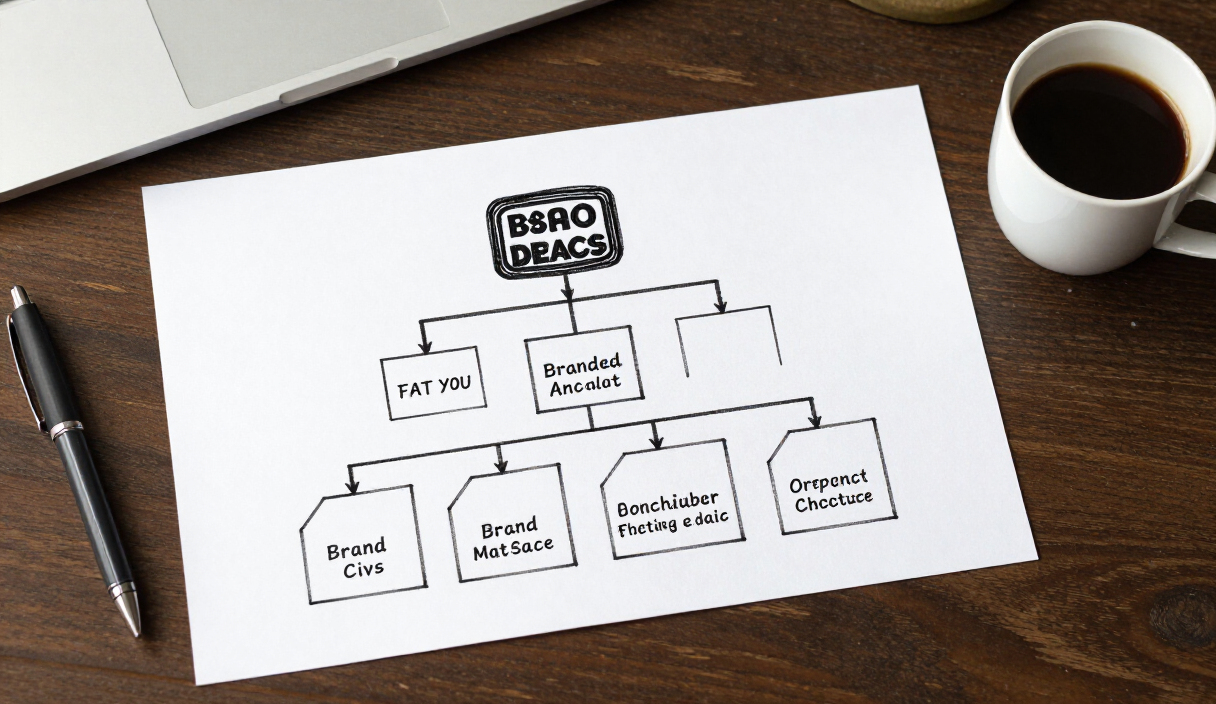
Building in public is often treated as a marketing format: a stream of screenshots, launch notes and progress updates designed to attract an audience before the product is finished. The more useful interpretation is less theatrical. Building in public can be a decision discipline—a way to make choices visible, expose trade-offs and prevent ambition from quietly turning into sprawl.

Get business pricing on office and shipping supplies
- Business-only prices and quantity discounts
- Tax-exempt purchasing
- Multiple users, one account, clear invoices
Business & Gründer · Decision discipline
The founder skill that matters most: deciding what not to build
Gewerkton’s strategy is visible in its boundaries: consolidate the brand, define three clear jobs—and reject plausible distractions before production speed turns them into sprawl.
Building in public should expose choices and trade-offs—not manufacture certainty through a stream of visible motion.
One brand. Three distinct jobs.
A branded-house architecture keeps every capability inside one legible construction workflow.
Domains consolidated
Ten possible destinations became one source of truth, aligned with one brand and an EUIPO trademark.
The rejected list
Adjacency was not enough to justify the operational and narrative weight of another category.
Packages in one night
A solo founder directed coding agents using Codex and Claude; output was verified with negative controls and mutation tests. More capacity made restraint more important.
AI providers, not 13 products
BYO-AI lets users choose providers by region across the EU, US and Asia, including mainland China—within one platform and without vendor lock-in.
Roadmap honesty is part of the product
Gewerkton distinguishes present capability from future intent instead of presenting planned work as delivered.
Gewerkton offers a particularly instructive example. It is a voice-first construction documentation and defect management platform for global markets, born in the German market and organised as one brand with three product lines: Field, Studio and Cloud. Behind that apparently simple structure sits a series of deliberate decisions: ten domains consolidated into one, an EUIPO trademark, a branded-house architecture and a rejected list that includes both a CAD clone and a payment product.
That rejected list may be the most valuable part of the story. Founders are routinely celebrated for what they ship. They are less often judged by the adjacent products, attractive distractions and plausible extensions they decline to pursue. Yet saying no is one of the few reliable ways to keep a product legible—to customers, to collaborators and to the founder.
As an affiliate, we earn on qualifying purchases.
Build-in-public should reveal decisions, not manufacture certainty
The familiar version of building in public rewards visible motion. New features produce updates. New product names produce announcements. A broader roadmap creates the impression of momentum. The problem is that activity and clarity are not the same thing. A company can show constant progress while making its proposition harder to understand with every release.
A decision-led approach asks different questions. What belongs under the brand? Which capabilities deserve a distinct product line? Which ideas should remain outside the boundary? What is genuinely available, what is in beta and what is merely being planned?
Gewerkton’s structure answers those questions without pretending the company has reached a finished state. The product is in beta now, with a public beta planned for fall 2026. That distinction matters. A beta badge is not a weakness to disguise; it is useful information for anyone evaluating the platform. It tells operators what stage they are entering and gives the company a clear standard for describing its current position.
The same principle applies to roadmap items. Showing in-planning chips instead of presenting future work as if it already exists turns the roadmap into an honesty tool. It separates intention from delivery. For founders, that creates healthy pressure: the public description must remain aligned with the actual product. For prospective users, it reduces the work of decoding vague promises.
browser workspace for plans and models
As an affiliate, we earn on qualifying purchases.
As an affiliate, we earn on qualifying purchases.
One brand, three clear jobs
A branded house can look conservative beside a collection of individually named products. In practice, it can be the more demanding choice. Every product line must strengthen the same promise, use the same language and make sense as part of the same system. There is less room to hide an incoherent idea behind a fresh logo.
Gewerkton has chosen one brand and three product lines. Each line has a defined role, and the boundaries describe a workflow rather than three unrelated markets.
- Gewerkton Field is the voice-first construction site app. It turns dictation into evidence, defects, daywork reports and takt workflows, and includes a portal.
- Gewerkton Studio is the browser workspace for plans and models. Where no model exists, the site team can create one in the browser.
- Gewerkton Cloud handles operations and model or data coordination between Field, Studio and third parties.
The names do useful work. Field is where site activity is captured. Studio is where plans and models are handled in the browser. Cloud connects operations and coordinates data. A founder deciding whether to add another product line now has a practical test: does the idea represent a genuinely distinct job inside this system, or is it simply a capability that could fit within an existing line?
This is the advantage of architecture as discipline. It does not eliminate new ideas. It gives those ideas somewhere to be tested before they become permanent additions to the company’s public identity.
cloud operations data coordination software
As an affiliate, we earn on qualifying purchases.
As an affiliate, we earn on qualifying purchases.
Ten domains became one
Domain consolidation can sound like administrative housekeeping. For an emerging brand, it is more consequential. Ten domains can imply ten destinations, ten explanations and ten opportunities for the audience to wonder whether it has arrived at the right place. Consolidating them into one establishes a single source of truth.
That choice is consistent with the branded-house model. One brand should have one obvious home. Field, Studio and Cloud can retain dedicated pages while remaining parts of a coherent whole. The EUIPO trademark adds another layer to that consolidation: the name is treated as a central asset, not a temporary wrapper around a loose collection of experiments.
The broader lesson is not that every founder needs exactly one domain or three product lines. It is that brand structure should reflect a decision, not the accumulated residue of past launches. Domains are cheap to register, product names are easy to invent and landing pages are quick to publish. The resulting complexity is not cheap. Someone must explain it, maintain it and help customers navigate it.
Consolidation is therefore a product decision as much as a marketing decision. It reduces the number of stories the company is asking the market to remember.
project management tools for founders
As an affiliate, we earn on qualifying purchases.
As an affiliate, we earn on qualifying purchases.
The rejected list is part of the strategy
Gewerkton deliberately did not build a CAD clone. It also did not build a payment product. Both refusals matter because both ideas could be made to sound adjacent to construction workflows. Plans and models are central to Studio; commercial processes are part of construction operations. Adjacency alone, however, is not a sufficient reason to create another product category.

The CAD decision helps clarify what Studio is. It is a browser workspace for plans and models, including the ability for a site team to create a model in the browser where none exists. That definition does not require the company to reproduce an entire CAD category. The boundary keeps attention on the site workflow the product is meant to serve.
The payment decision performs a similar function. Gewerkton’s deepest commercial integration is in Germany, including GAEB, REB, XRechnung and DATEV. Those integrations are concrete parts of the platform’s position. They do not automatically require a separate payment product. Refusing that expansion prevents commercial integration from becoming an excuse to enter every neighbouring transaction layer.
For founders, this is where strategy becomes uncomfortable. The difficult “no” is rarely reserved for a ridiculous idea. It is usually applied to an idea with a plausible pitch, a recognisable market and some connection to the core product. The founder’s job is to decide whether that connection is strong enough to justify the operational and narrative weight that follows.
A rejected list makes that reasoning visible. It also protects the team—even when the team is unconventional—from repeatedly reopening settled debates. Gewerkton is built by a solo founder directing a fleet of coding agents using Codex and Claude. In one night, that fleet shipped 21 software packages, verified with negative controls and mutation tests. That level of production capacity makes restraint more important, not less. When building becomes faster, the cost of an undisciplined “yes” can be hidden until the product estate has already expanded.
Speed increases the need for boundaries
Agent-assisted development changes the relationship between an idea and a working implementation. A founder can direct substantial output without assembling a conventional software team for each workstream. But the ability to ship more packages does not answer the strategic question of which packages should exist.
This is why decision discipline sits above production speed. Coding agents can execute, test and iterate. They cannot remove the founder’s responsibility for product coherence. If anything, a fleet capable of producing quickly raises the value of a sharply defined brief, a stable naming system and a visible list of exclusions.
The same distinction applies to infrastructure choices. Gewerkton’s BYO-AI approach supports 13 AI providers. Users bring their own keys and can select providers by region across the EU, US and Asia, including mainland China, avoiding vendor lock-in. Data residency is also a choice: EU cloud or the customer’s own infrastructure.
Those are not reasons to create 13 differently branded AI products or multiple regional versions of the company. They are capabilities within one platform, designed for projects that may span different operating environments.
A global platform with a specific point of origin
Gewerkton describes itself as a platform for global markets, but it does not erase where it began. It was born in the German market and retains its deepest German commercial integration through GAEB, REB, XRechnung and DATEV. At the same time, it supports 27 content languages and regional AI-provider choice across the EU, US and Asia, including mainland China.
That combination is more precise than calling the product generically international. It identifies both depth and range. The platform has a specific commercial integration base, while multilingual capture, reporting and provider selection address work across regions.
The deployment fields show why that matters. Wind farms and renewables involve distributed sites, rotating crews, field acceptance and offline capture in dead zones. Data centres and industrial plants can have many trades working in parallel under tight deadlines, with meeting decisions becoming trade-sorted task lists. Housing and building construction involve defects with photos and deadlines, dictated daywork reports and signatures on the device at handover.
Infrastructure and tunnel projects run over long periods, generate many change orders and may require instructions to be backed by original audio. Cross-border teams can include people in the EU, US and APAC working on the same project, each using their own language while the evidence original remains unambiguous. On projects in Asia, Chinese, Korean and Vietnamese crews can work multilingually from capture through to report, with data residency selected by the operator.

These settings vary, but they reinforce the same core proposition: voice-first construction documentation and defect management, connected across field capture, browser-based plan and model work, and operational data coordination. The product architecture holds because the use cases change without requiring the brand to reinvent itself for each sector or region.
The marketing system follows the same logic
The public-facing operation also reflects deliberate constraint. Gewerkton’s marketing site is available in 27 languages, uses zero trackers, requires no cookie banner and runs on a fully egress-free architecture. Its media bank contains more than 51 self-produced clips and posters.
There is substantial content, but the central line remains concise: “On site, what counts is what’s proven.” That statement ties the marketing back to the work. Dictation becomes evidence. Defects carry photos and deadlines. Daywork reports can be dictated. Instructions can retain original audio. The message does not need a separate identity for every format, language or deployment field.
This is another benefit of a branded house. Content can expand while the proposition stays stable. A large media bank does not have to become a collection of disconnected campaigns. Twenty-seven language versions do not require 27 different brand stories. Distribution grows around the centre rather than pulling the centre apart.
The roadmap should show uncertainty accurately
Founders often worry that visible uncertainty will reduce confidence. The greater risk is misplaced confidence created by language that blurs what exists and what is intended. When a product is in beta, say it is in beta. Gewerkton is in beta now, and its public beta is planned for fall 2026. When an item is being planned, label it as in planning. When an idea has been rejected, do not leave it hovering as an implied future expansion.
This approach makes the roadmap more than a sales device. It becomes a record of current commitments and their status. Beta badges prevent unfinished work from being presented as settled. In-planning chips prevent a proposal from being mistaken for a delivered capability. The rejected list protects the company from the assumption that every adjacent opportunity will eventually enter the product.
None of this requires a founder to stop thinking expansively. It requires expansive thinking to pass through a filter before it becomes a promise.
Saying no is how the product remains understandable
Gewerkton’s public story contains plenty of scale: three connected product lines, 27 content languages, 13 AI providers, more than 51 self-produced media assets and a fleet that shipped 21 tested software packages in one night. The strategic centre, however, is restraint.
One brand replaces a collection of identities. One domain replaces ten destinations. Field, Studio and Cloud divide the platform into comprehensible jobs. The current beta status and fall 2026 public-beta plan are stated plainly. Planned work is labelled as planned. A CAD clone and a payment product sit on the rejected list rather than being kept alive as vague possibilities.
That is build-in-public at its most useful. It does not merely display output. It exposes the boundaries around the output. For founders and operators, those boundaries are where credibility is built: in the difference between available and planned, between integrated and expanded, and between something that can be built and something that should be built.
Halloween Picks
halloween
As an affiliate, we earn on qualifying purchases.