

TL;DR
OpenAI launched ChatGPT Wallet on November 13, 2026, allowing its dots agents to complete purchases on a user’s behalf. At launch, eligible U.S. ChatGPT Pro subscribers must review and approve every purchase with a security check; spending limits and autonomous buying are not available yet.
OpenAI launched ChatGPT Wallet on Friday, November 13, giving its cloud-based dots agents a way to complete online purchases after a user reviews the order and approves payment with a security check. The initial rollout is limited to ChatGPT Pro subscribers aged 18 or older in the United States with eligible U.S.-issued cards, and each purchase requires individual approval.

Get business pricing on office and shipping supplies
- Business-only prices and quantity discounts
- Tax-exempt purchasing
- Multiple users, one account, clear invoices
OpenAI says a dot can shop on a business’s own website and fill a cart. Before payment, Wallet presents the items, total and selected card for the user to review. The user then confirms the purchase with a security check, such as Face ID or a fingerprint. OpenAI says the approval is recorded. A dot cannot currently buy without that step.
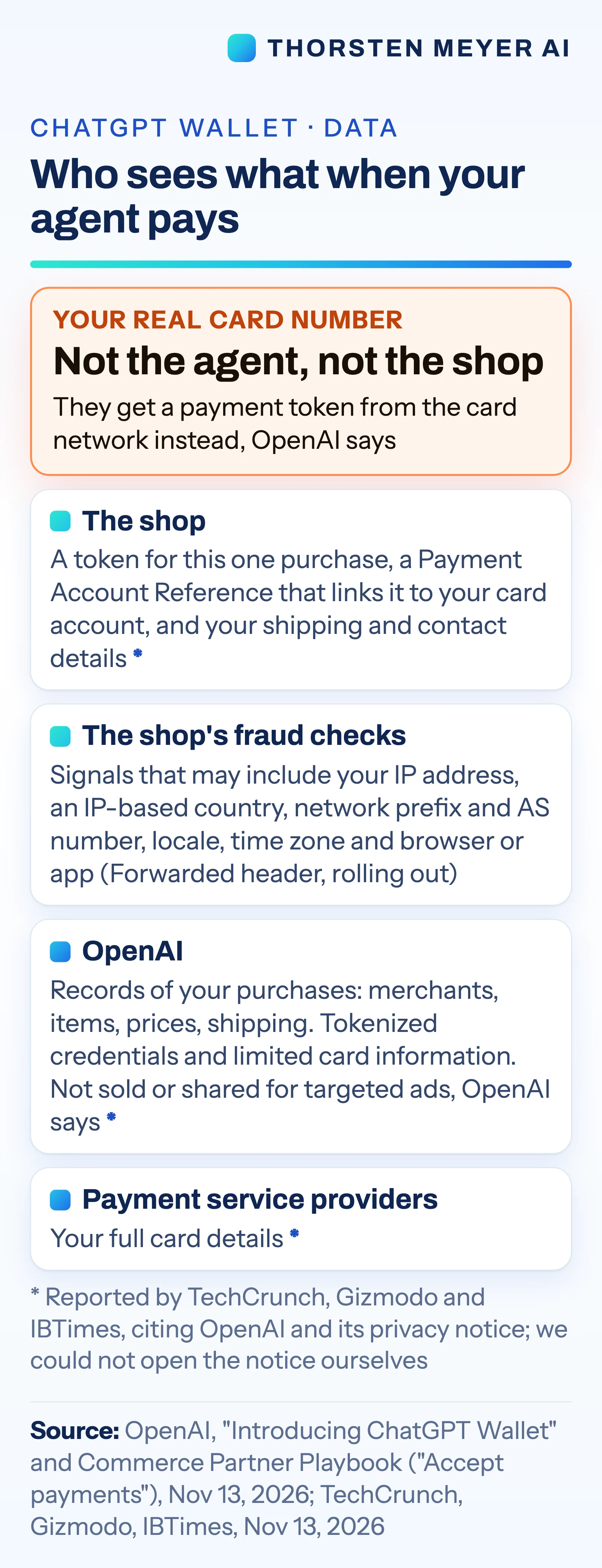
For payment, the card network issues a token with its own card number, security code and expiry date. OpenAI says the merchant and the agent do not receive the user’s actual card details. The merchant still receives order details and may receive signals used for fraud checks, including an IP-based country and the user’s time zone. OpenAI says the arrangement is designed to keep real card credentials from the agent and the shop.
OpenAI says the wallet was built in partnership with American Express, Mastercard and Visa. The source material also identifies certain Chase cards among those reported as supported, but the launch announcement’s full eligibility list is not provided here. Access is described as limited to dots at launch; broader language in OpenAI’s news feed refers to agents in ChatGPT Work and Codex as well, but those surfaces are not part of the initial rollout described in the source material.
A New Step at Online Checkout
The launch gives OpenAI’s agents a route from product research and cart filling to payment. OpenAI says 1.2 billion people use ChatGPT each week and that many use it to research products, compare options and make buying decisions. That figure and description come from OpenAI; the company has not provided evidence here about how many users will use Wallet or how often.
For shoppers, the immediate change is that an agent can prepare a purchase for approval without being given the actual card number, according to OpenAI. The required review and security check keep the user involved at checkout. For merchants, agent-led purchases may add a new source of orders, but they can also create technical and fraud-screening challenges: OpenAI’s materials say many websites and fraud systems still block or decline purchases made by agents.
The launch also tests how responsibility is divided when software shops for a person. OpenAI says returns and customer service remain with the merchant, while eligible disputes use the card’s existing protections. Its merchant guidance says customers are ultimately responsible for actions they take. Those terms make the user’s approval step and the merchant’s acceptance of agent traffic central to how the service works in practice.
Products Worth Considering

Canon PIXMA TR160 Wireless Portable Color Inkjet Printer

FLEXISPOT Electric Adjustable Workbench, 55 x 28 Inches, White

FlexiSpot E6 Electric Standing Desk, 55 × 28 in, Bamboo Top, White Frame
As an affiliate, we earn on qualifying purchases.
From Cart Research to Payment
OpenAI describes dots as always-on agents that live in the cloud and have their own computer and browser. That setup allows them to keep working while a user’s own computer is off. Before Wallet, OpenAI’s material says a dot could research products and fill a cart, but payment remained the step it could not complete for the user.
OpenAI presents Wallet as a way to let agents pay without access to actual card details and with a security check for every purchase, while retaining existing card rewards and protections for eligible disputes. Those descriptions are claims made by OpenAI, not independent findings in the supplied material. The company’s announcement also calls the product the first wallet with those features; the source notes that critics question how new that combination is, but does not provide their arguments or identify the critics.
This is not OpenAI’s first effort to support purchases. According to IBTimes, the company introduced Instant Checkout in September 2025, enabling users to buy selected products in chat. The Decoder reported that OpenAI later dropped it because it was not flexible enough and built Wallet afterward. Those accounts provide context for the new approach, but the supplied material does not include OpenAI’s own detailed explanation of that earlier product’s end.
““An agent making a purchase should strengthen, not bypass, the trust built into payments.””
— Sherri Haymond, Mastercard’s head of digital commercialization
Limits on Access and Agent Buying
OpenAI has not yet made spending limits or pre-approved purchases available. The company says those features may come “over time,” but the supplied material gives no timetable or details about how users could set limits by amount, category or time period. For now, every purchase requires a review and security check.
The launch is restricted to eligible U.S. ChatGPT Pro subscribers aged 18 or older using eligible U.S.-issued cards and dots. The complete list of supported cards, the pace of the rollout and any plans for other countries or subscription tiers are not specified in the source material. OpenAI’s broader description of agents in Work and Codex does not establish when, or whether, Wallet will become available in those products.
It is also unclear how widely merchants will accept purchases initiated by agents, or how often fraud systems will decline them. OpenAI says a merchant sees certain fraud signals, but the supplied material does not explain the full data flow, how those signals are handled or what happens when a payment is flagged. OpenAI has not provided adoption figures, transaction outcomes or independent evidence here to support its claims about the wallet’s novelty and protections.
Rollout and Spending Controls
OpenAI says the wallet is beginning its rollout to eligible ChatGPT Pro users. Its stated next step is to learn from real-world use and work with partners; the supplied announcement text does not set a date for wider availability. Users who qualify can expect to review each order and approve payment individually during this initial phase.
OpenAI has said that purchase controls, including spending limits and pre-approved purchases, are expected “over time.” No release date or detailed operating rules were given. The practical next indicators will be whether OpenAI expands access beyond U.S. Pro subscribers, adds more agent surfaces, and publishes details about merchant acceptance and how payment issues are resolved.
Key Questions
Who can use ChatGPT Wallet at launch?
OpenAI says the initial rollout is for ChatGPT Pro subscribers aged 18 or older in the United States with eligible U.S.-issued cards. Wallet is available through dots in this launch phase.
Does a dot buy something without approval?
No. The user must review the items, total and selected card and approve each purchase with a security check. OpenAI says spending limits and pre-approved purchases are not available yet.
Does the shop see the real card number?
OpenAI says the payment uses a card-network token with its own payment credentials, so the merchant and agent do not receive the actual card details. The merchant does receive order details and may receive signals such as an IP-based country and time zone for fraud checks.
Who handles returns or a payment dispute?
According to OpenAI’s materials, returns and customer service remain with the merchant. Eligible disputes use the card’s existing protections. The source material does not detail how a customer should handle a particular dispute or return.
Source: Thorsten Meyer AI