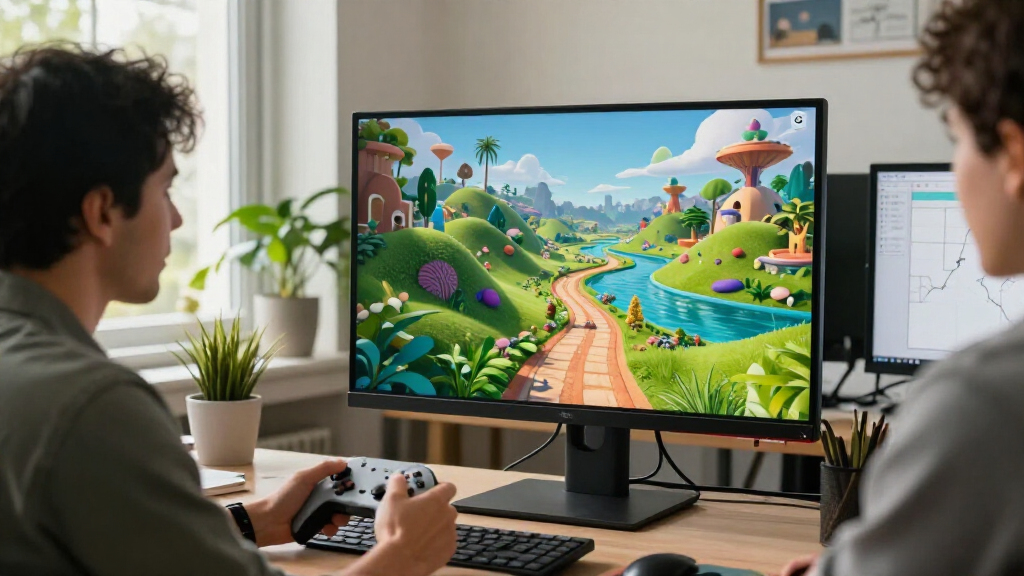

🔍 Read the full analysis: Google’s Genie 4 Builds Virtual Worlds You Can Wander Through on ThorstenMeyerAI.com

Get business pricing on office and shipping supplies
- Business-only prices and quantity discounts
- Tax-exempt purchasing
- Multiple users, one account, clear invoices
TL;DR
Google DeepMind showed Genie 4 on October 27, 2026, describing it as a real-time AI model that generates interactive scenes from prompts and responds to movement and further instructions. The demos are company-selected, the model is not publicly available, and DeepMind says scenes can drift after a few minutes of interaction.
Google DeepMind presented Genie 4 on October 27, describing an AI model that generates scenes people can move through and change while they run. The announcement matters because it pairs interactive, prompt-driven environments with real-time sound generation, though the demonstrations were selected by Google and access remains limited.
In DeepMind’s example, a user describes a misty lake at dawn with a saxophone player on a floating platform, then moves through the generated scene with keyboard controls. A user can also type an instruction such as changing the weather. DeepMind says the model generates the next frame in response to what has happened and to the user’s actions, rather than rendering a world from a stored 3D map as a conventional game engine would.
The company describes four main capabilities: steering a scene with keyboard or mouse input, changing it through text, generating sound alongside images, and modeling people and physical events. DeepMind says the audio can include environmental sounds, music and dialogue. These descriptions come from the company’s own announcement and demonstration clips; it did not publish benchmark figures for the claims.
DeepMind also says Gemini 3.8 Flash can monitor scenes, interpret instructions and break tasks into steps. In a robotics-related demonstration, a Gemini model guided a simulation of an Apptronik Apollo humanoid playing checkers. The source material says no physical robot took part; this was a research simulation, not a demonstration of a real robot performing the task.
Infographic 01 · How Genie grew up
From flat sketches to worlds with sound, in under three years.
Each step as Google DeepMind described it. Session limits and consistency are different measures, so read the labels.
- Feb 2024
Genie 1Simple 2D worlds11 billion parameters, learned from unlabelled internet videos - Dec 2024
Genie 23D worlds from a single imageConsistent “for up to a minute”; real time only as a slimmed-down, lower-quality version - Aug 2025
Genie 3First real-time Genie720p at 24 frames per second, consistent “for a few minutes”, memory about one minute back - Jan 2026
Project GenieUS AI Ultra subscribers can play60 seconds per world, partly because of compute costs - May 2026Project Genie goes globalIn the $200 AI Ultra tier, for users 18 and older
- 27 Oct 2026
Genie 4Sound, live steering, more realismResearch preview for trusted testers; Ultra subscribers and API partners “coming soon”
Genie 3 vs. Genie 4
As described by Google DeepMind. Genie 4 column = vendor claims unless marked.
| Feature | Genie 3 (Aug 2025) | Genie 4 (Oct 2026) |
|---|---|---|
| Sound | Genie 3: None | Genie 4: Generated with the picture: ambient noise, music, dialogue |
| Steering | Genie 3: Keys, plus “promptable world events” | Genie 4: Free-form text changes while it runs; Gemini adapts and checks them |
| Look | Genie 3: 720p, 24 fps | Genie 4: “Unprecedented realism”; no resolution or frame rate published |
| How long | Genie 3: “A few minutes”; Project Genie capped at 60 s | Genie 4: “A few minutes” (DeepMind); up to ~2 min consistent scene reported |
| Access | Genie 3: Small preview, then Project Genie | Genie 4: Trusted testers; Ultra and API partners “coming soon” |
Sources: Genie paper, arXiv, 23 Feb 2024; Genie 2 blog, 4 Dec 2024; Genie 3 blog, 5 Aug 2025; TechCrunch, 29 Jan 2026; Google, 19 May 2026; Google DeepMind, Genie 4 blog, 27 Oct 2026; Genie 4 model page (limitations, disclaimer); TechCrunch, 27 Oct 2026. Table wording: Thorsten Meyer.
Powered by Thorsten Meyer AI
From Generated Clips to Interactive Scenes
Genie 4 points toward a different use of generative AI: rather than creating a finished clip for someone to watch, a world model attempts to keep producing a scene as a person moves through it. If the approach becomes more reliable, it could offer creators a way to explore visual ideas interactively and give researchers simulated environments for testing tasks.
DeepMind reports that testers have used the system for film previsualization and game prototypes. Those are reported examples of early feedback, not evidence of broad commercial adoption or measured productivity gains. The robotics demo likewise suggests a potential research use, but does not establish that Genie 4 is ready to train robots for real-world work.
The model’s sound generation also has implications for how synthetic media is recognized. DeepMind says Genie 4 video and audio outputs carry an invisible SynthID watermark. That is the company’s stated provenance measure; the announcement does not provide independent testing of how reliably the watermark can be detected after content is altered or shared.
Products Worth Considering

Logitech MX Mechanical Full-Size Wireless Mechanical Keyboard, Tactile Quiet Switches, Backlit Keys, Bluetooth, USB-C, Multi-Device, Graphit

Logitech MX Master 4 for Mac, Ergonomic Bluetooth Mouse with Haptic Feedback, Ultra-Fast Scrolling, USB-C Charging, for MacOS, iPadOS, Windo

LG UltraGear 27-Inch QHD OLED Gaming Monitor, 240Hz, 0.03ms, G-SYNC Compatible, FreeSync Premium Pro, HDMI 2.1
As an affiliate, we earn on qualifying purchases.
Genie’s Move Toward Real Time
Genie 4 follows a series of DeepMind world-model projects. The first Genie, introduced in February 2024, generated simple two-dimensional environments. Genie 2, announced in December 2024, generated three-dimensional worlds from a single image and maintained consistency for up to a minute, according to the company’s description.
Genie 3, announced in August 2025, was described by DeepMind as its first world model to run in real time, at 720p and 24 frames per second, with consistency lasting a few minutes. Google later made Genie 3 available to some paying US subscribers through Project Genie, according to the supplied source material. Waymo, Google’s self-driving car company, already uses the predecessor Genie 3 to build a driving simulator, the source says.
Genie 4’s planned access is narrower for now: DeepMind says it will be available to trusted testers, with a later rollout planned for Google AI Ultra subscribers through Project Genie and early Gemini API partners. The source identifies AI Ultra as a $200-per-month tier, but Google has not provided a Genie 4 API price or a release date.
“Details and objects “can shift or drift over time.””
— Google DeepMind, describing Genie 4’s limitations
Access, Session Length and Reliability
Genie 4 is not yet available to the public. DeepMind has not announced a date for access through Project Genie or the Gemini API, nor has it disclosed API pricing. The company says sessions can last a few minutes, while TechCrunch and Bloomberg, as cited by heise, have reported scenes lasting about two minutes. That more specific figure is not in DeepMind’s own wording.
It is also not clear how consistently Genie 4 can preserve scene details during extended use, or how its performance compares with other systems under controlled tests. DeepMind has published no benchmark numbers in the supplied material. Its demonstrations were selected by the company, so they do not show how often the model fails across ordinary prompts or longer sessions.
Reported early uses should be read with the same caution. Tester feedback about film and game work is not a public evaluation of finished projects, and the robotics example was simulated. The source material also notes that other companies have demonstrated audio-generating world models, so DeepMind’s “first” wording applies to its own model rather than the broader field.
Limited Tests Before Wider Release
The next step is testing with trusted users and early partners. DeepMind says it plans to bring Genie 4 to Google AI Ultra subscribers through Project Genie and to early Gemini API partners, but it has not said when either group will receive access. A date, API price and details of usage limits remain unannounced.
Those tests will help clarify whether the model can maintain stable scenes beyond short demonstrations, how well its generated audio follows changes in the environment, and what developers can build with it. Until access expands and independent evaluations become available, the capabilities and limits described here remain based mainly on Google’s account and selected demos.
Key Questions
What is Google Genie 4?
Genie 4 is a Google DeepMind world model. The company says it generates interactive scenes frame by frame in response to movement and text instructions, with sound produced alongside the visuals.
Can the public use Genie 4 now?
No. DeepMind says access is for trusted testers, with a planned later rollout to Google AI Ultra subscribers through Project Genie and early Gemini API partners. It has not announced a public release date.
How long can a Genie 4 world run?
DeepMind describes a few minutes of continuous interaction and warns that objects and details can drift. TechCrunch and Bloomberg, as cited by heise, reported scenes of about two minutes, but that specific figure is not stated in DeepMind’s supplied announcement material.
Does the robotics demonstration involve a real robot?
No. The cited demonstration simulated an Apptronik Apollo humanoid playing checkers; the source material says no physical robot was involved.
What remains unproven about Genie 4?
DeepMind has not supplied benchmark results showing how reliably Genie 4 maintains a scene, follows instructions or performs compared with other models. Its public examples are company-selected demonstrations, and independent evaluations are not yet available in the source material.
Source: ThorstenMeyerAI.com