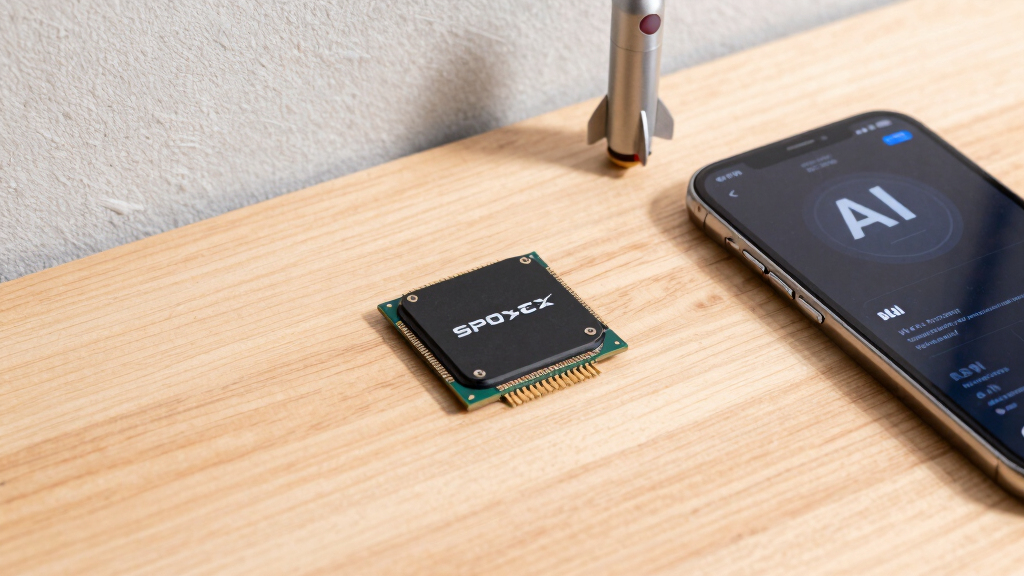

📊 Full opportunity report: SpaceX Owns Every Layer of AI Now. The Model Is Still the Weak Link. on ThorstenMeyerAI.com — validation score, market gap, and execution plan.

Get business pricing on office and shipping supplies
- Business-only prices and quantity discounts
- Tax-exempt purchasing
- Multiple users, one account, clear invoices
TL;DR
SpaceX has bought Cursor for $60 billion, gaining control over all AI infrastructure layers except the model itself. The move consolidates its position as a leading AI conglomerate, but the AI model remains a vulnerability.
SpaceX has completed a $60 billion all-stock acquisition of Cursor, a profitable AI coding application company, consolidating control over every layer of the AI technology stack except the AI model itself. This move significantly enhances SpaceX’s position in the AI industry, making it one of the most vertically integrated players globally.
On June 16, SpaceX announced that it has exercised its option to acquire Cursor, a leading AI coding company founded in 2022, for $60 billion in all-stock. Cursor, which generated approximately $4 billion in annualized revenue, specializes in AI tools for software development and has been profitable, with major clients including Microsoft and Google, which lease significant compute resources from Cursor.
This acquisition gives SpaceX ownership of Cursor’s profitable application, its developer distribution network, and its AI model team—integrated into SpaceX’s broader AI infrastructure. The deal is set to close in the third quarter of 2026, after which Cursor will become a wholly owned subsidiary.
Prior to the acquisition, SpaceX had already built an extensive AI infrastructure, including the Colossus supercomputers in Memphis, which run around 555,000 Nvidia GPUs, and plans to deploy AI satellites as orbital data centers. The company owns and operates its own silicon, power generation, and research labs, making it a unique, fully integrated AI entity in the West.
However, despite controlling all these layers—compute, power, research, and distribution—the core AI model remains a weak point. The models used by Cursor and other AI applications are not yet at the same level as the infrastructure they run on, which poses a potential vulnerability for SpaceX’s AI ambitions.
SpaceX owns every layer
of AI now
The $60B Cursor buy completes the stack: power, compute, research, model, app, distribution. But owning every layer isn’t winning every layer — and the model is the weak one.
(Anysphere)
You can buy a coding app and a model team. You can’t buy the research lead that makes your foundation model the one everyone else builds on — which is why Anthropic pays Musk $1.25B/month, not the other way around. Owning every layer bought SpaceX the right to attempt the hard thing. It hasn’t done it yet.
Implications of SpaceX’s Vertical Integration in AI
This move positions SpaceX as a dominant force in AI infrastructure, controlling not only the hardware and data centers but also the application layer. Such integration could reshape industry dynamics, potentially limiting competition and consolidating AI development within a single corporate entity.
However, the fact that the AI model itself remains a weak link highlights ongoing challenges in AI development—namely, creating models that can match the capabilities of the infrastructure. If the models do not improve, this could limit the effectiveness of SpaceX’s AI applications and its strategic dominance.
For industry competitors and regulators, the consolidation raises questions about market power, access to compute, and the future of AI innovation in a highly centralized ecosystem.
high-performance AI development GPU
As an affiliate, we earn on qualifying purchases.
As an affiliate, we earn on qualifying purchases.
Background on SpaceX’s AI Infrastructure and Cursor Acquisition
SpaceX has been rapidly building its AI capabilities, notably through the development of the Colossus supercomputers, which have been described as ‘superhuman’ in speed and scale. These systems, costing billions to develop, run hundreds of thousands of GPUs and are designed to support large-scale AI training and deployment.
In June 2026, SpaceX announced the acquisition of Cursor, a profitable AI coding company that had previously rebuffed offers from OpenAI and Microsoft, emphasizing independence. Cursor’s model training involved tens of thousands of xAI chips, and its revenue model includes leasing compute to major AI labs like Google and Anthropic, generating hundreds of millions monthly.
This acquisition completes SpaceX’s control over the entire AI stack—compute, power, research, and application—except for the AI models, which are still in development and considered the weak link. The company’s strategy appears to be creating an integrated AI ecosystem that leverages its hardware and software assets for competitive advantage.
“This acquisition accelerates our AI ambitions and integrates our hardware, software, and applications into a cohesive ecosystem.”
— SpaceX spokesperson
As an affiliate, we earn on qualifying purchases.
Unresolved Questions About the AI Model’s Capabilities
It is not yet clear how advanced or competitive SpaceX’s own AI models are relative to industry leaders like OpenAI or Google DeepMind. The models are described as the ‘weak link,’ but specific performance metrics, training data quality, and development timelines remain undisclosed. Additionally, it is uncertain how the company plans to improve the models or whether existing models will be sufficient for future applications.
professional AI coding workstation
As an affiliate, we earn on qualifying purchases.
As an affiliate, we earn on qualifying purchases.
Next Steps for SpaceX’s AI Strategy and Model Development
SpaceX is expected to accelerate AI model research and development, potentially integrating new models into Cursor and other applications. The company may also seek strategic partnerships or acquisitions to bolster its AI model capabilities. Monitoring how the models evolve and whether they can match the infrastructure’s scale and speed will be critical in assessing the long-term success of SpaceX’s AI ambitions.
Regulators and industry observers will also watch for any market impacts or regulatory responses to SpaceX’s increasing control over AI infrastructure and applications.
As an affiliate, we earn on qualifying purchases.
Key Questions
Why did SpaceX buy Cursor for $60 billion?
SpaceX acquired Cursor to control a profitable AI application, its developer network, and a talented AI model team, completing its vertical integration across the AI stack.
What does controlling all AI infrastructure layers mean for the industry?
It positions SpaceX as a dominant, highly integrated AI player, potentially limiting competition and reshaping market dynamics, but the success depends on the strength of its AI models.
Why is the AI model considered the weak link?
The models currently used are not yet at the same level as the infrastructure, with limited performance and capabilities, which could hinder overall AI effectiveness.
What are SpaceX’s future plans for AI development?
Expect continued investment in AI model research, possible new model releases, and integration into existing applications, with ongoing assessment of model performance and competitiveness.
How does this acquisition affect global AI competition?
It consolidates significant AI infrastructure within a single company, potentially giving SpaceX an edge but raising concerns about market concentration and access to AI technology.
Source: ThorstenMeyerAI.com
Fall Picks
fall essentials
As an affiliate, we earn on qualifying purchases.