
TL;DR
Thorsten Meyer AI has released Outcome-First Decisions, an open-source decision framework for reviewing active initiatives by current outcomes and ongoing cost. The framework returns three verdicts: keep, change or kill, with a stated bias toward making stalled work easier to end.
Thorsten Meyer AI has released Outcome-First Decisions, an open-source framework meant to help operators decide whether active projects should be kept, changed or killed, according to the site’s Day 8 Built in Public dispatch.
The framework centers on what Thorsten Meyer AI calls the Worth Filter: a forward-looking test that asks whether an initiative’s current or expected outcome is worth the cost of continuing it. The dispatch says past effort, sunk cost and identity are excluded from the decision.
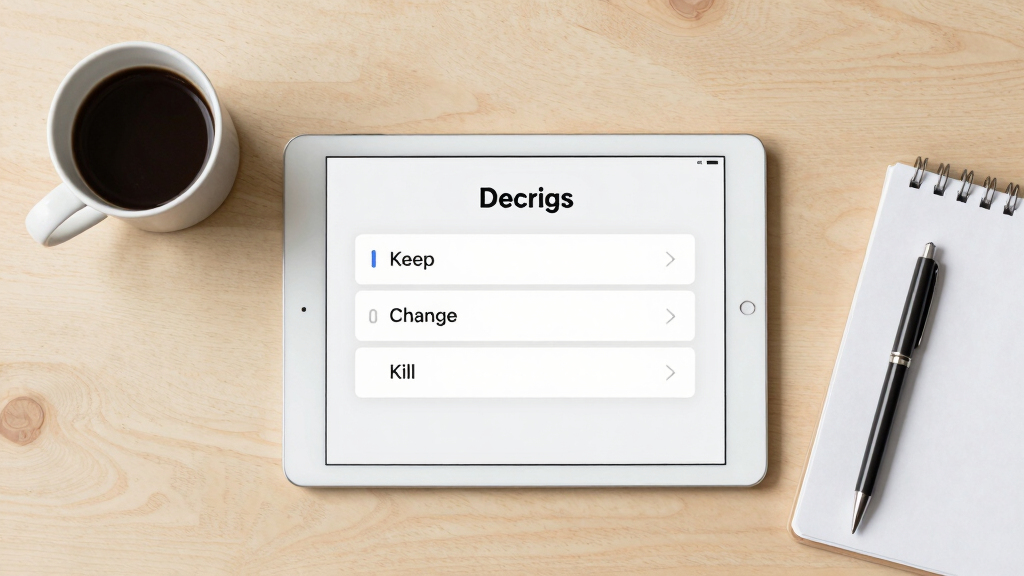
Outcome-First Decisions produces one of three verdicts. Keep means the outcome justifies the cost. Change means the underlying idea may still have value, but the current form is not working. Kill means the outcome does not justify further upkeep and the work should be ended cleanly.
The project is described by Thorsten Meyer AI as local-first, provider-agnostic and open source under the AGPL-3.0 license. The source material also states that it is provided without warranty and that its verdicts are decision support rather than final decisions.
Outcome-First Decisions — keep, change, or kill
The hardest decision isn’t what to start — it’s what to stop. Judge every initiative by the outcome it produces now, not the effort already spent.
Independent commentary, produced with AI assistance under human editorial oversight. The views are the author’s own and may change. Outcome-First Decisions is open source under AGPL-3.0, provided “as is” without warranty; see the repository LICENSE. The framework’s verdicts are reasoning aids based on the inputs given and may be wrong — decision support, not decisions; verify independently before acting. Product and company names are trademarks of their respective owners; mention does not imply endorsement.
Stopping Becomes A Formal Verdict
The release matters because many portfolios accumulate projects that continue by default even after their value is no longer clear. Thorsten Meyer AI frames that as a capacity problem: stalled initiatives can consume attention, maintenance time and capital that could be used elsewhere.
The framework’s main intervention is procedural rather than technical. By reducing a review to keep, change or kill, it gives teams and solo operators a direct way to discuss ending work without treating the decision as a failure. That could be useful for product portfolios, content operations, experiments and side projects where the cost of continuing is diffuse.

Soft Computing Evaluation Logic: The LSP Decision Method and Its Applications (IEEE Press)
As an affiliate, we earn on qualifying purchases.
As an affiliate, we earn on qualifying purchases.
Day 8 In The Decision Layer
Outcome-First Decisions is part of Thorsten Meyer AI’s Built in Public series, labeled Day 8 of 19 in the source material. The dispatch places it inside a broader “Decision layer,” following tools or concepts described as validate, plan and review.
The site also ties the framework to an operator portfolio of 18 products. In that setting, the stated purpose is to close the review loop by deciding which initiatives still earn their place and which should stop consuming capacity.
“The hardest decision isn’t what to start — it’s what to stop.”
— Thorsten Meyer AI dispatch

Program Management for Open Source Projects: How to Guide Your Community-Driven, Open Source Project
As an affiliate, we earn on qualifying purchases.
As an affiliate, we earn on qualifying purchases.
Adoption And Results Remain Open
It is not yet clear from the supplied source material how many users have adopted the framework, whether the GitHub repository has outside contributors, or how the tool performs across different types of organizations.
The source also does not provide case results, benchmarks or examples showing how often reviews lead to keep, change or kill outcomes. Any claims about business impact would need separate evidence.

Outcome-Based Performance Management for Hybrid Teams: The Manager’s Framework for OKRs, Continuous Feedback, Fair Reviews, and High-Impact Productivity
As an affiliate, we earn on qualifying purchases.
As an affiliate, we earn on qualifying purchases.
Repository Use Is The Next Test
The next milestone is likely practical use: whether operators apply the framework to real portfolios, report decisions publicly, or contribute changes through the AGPL-3.0 repository. Readers evaluating the method should verify the repository, review the license and treat outputs as inputs to judgment rather than automated decisions.
project kill or continue decision tools
As an affiliate, we earn on qualifying purchases.
As an affiliate, we earn on qualifying purchases.
Key Questions
What is Outcome-First Decisions?
It is a decision framework from Thorsten Meyer AI for reviewing whether initiatives should be kept, changed or killed based on current outcomes and ongoing cost.
What is the Worth Filter?
The Worth Filter is the framework’s main test. It asks whether the outcome an initiative is producing now, or is likely to produce next, is worth the cost of continuing it.
Is this a final decision-making system?
No. The source material describes the verdicts as reasoning aids and decision support, not final decisions. Users are told to verify independently before acting.
What license applies to the project?
Thorsten Meyer AI says Outcome-First Decisions is open source under the AGPL-3.0 license and available on GitHub.
Source: Thorsten Meyer AI