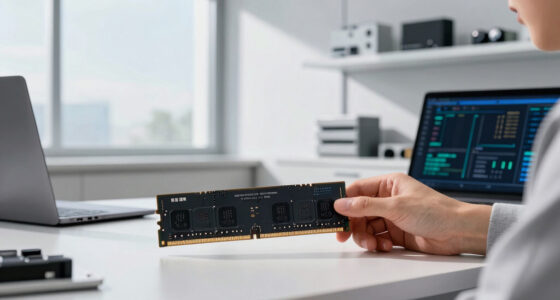

📊 Full opportunity report: Apple Is Reaching For Chinese Memory. Europe Doesn’t Even Have That Option. on ThorstenMeyerAI.com — validation score, market gap, and execution plan.
TL;DR
Apple is lobbying US authorities to purchase Chinese memory chips, exposing its dependence on China amid global shortages. Europe faces similar issues but has no domestic options, risking supply chain vulnerabilities.
Apple is lobbying Washington for permission to purchase memory chips from Chinese manufacturer CXMT, a company on the Pentagon’s blacklist. This move comes shortly after Apple raised prices on Macs and iPads, citing a global memory shortage, and underscores the company’s limited options for securing supply. The development highlights the broader issue of supply chain dependence for major tech firms.
According to sources, Apple’s lobbying effort aims to gain approval from US authorities to buy chips from CXMT, despite the company’s inclusion on the US Pentagon’s blacklist. This indicates Apple’s urgent need to secure memory components amid ongoing shortages, which have driven up prices for products like Macs and iPads. The company has alternative sources, such as Micron in the US, but the Chinese manufacturer presents a critical, albeit controversial, option.
While Apple’s move reveals its strategic flexibility, it also exposes a significant vulnerability: reliance on external, geopolitically sensitive supply chains. Europe, by contrast, has almost no domestic memory manufacturing capacity, making it even more dependent on external sources. Europe’s semiconductor industry is heavily concentrated outside the continent, with only a few key players and no significant memory fabrication capacity.
Apple is reaching for Chinese memory. Europe doesn’t even have that option.
The shortage exposes America’s dependence — and Europe’s far more brutally. Apple has a domestic supplier, political weight, and the China option. Europe has no memory of its own, no seat at the table, no leverage on what counts.
- EU makes < 10% of the world’s semiconductors
- Effectively no DRAM, no HBM from Europe
- 3–4 memory makers worldwide — none European
- Pure price-taker: memory ~4× in 3 quarters
- ASML: EUV monopoly — no leading-edge chip without it
- Zeiss: precision optics, unrivalled worldwide
- imec · CEA-Leti · Fraunhofer: world-class research
- Infineon, NXP, STMicro: automotive · power · SiC
The shortage is a sovereignty test — Europe fails on supply but still holds the leverage in its hand. If even Apple can’t buy its way out, Europe’s answer isn’t to buy its way in, but to run two tracks: press the unique chokepoints as real leverage — and cut dependence wherever it can without Brussels: local-first, open weights, quantization, right-sized hardware. Bury the 20% dream, defend what’s yours, need less.
Implications of Dependence for Global Tech Supply Chains
This development underscores the fragility of global semiconductor supply chains, especially for companies like Apple that rely heavily on external sources. For Europe, the situation is more dire, as it lacks the domestic manufacturing capacity to mitigate such risks. Europe’s dependence on Asian and US suppliers leaves it vulnerable to supply disruptions, price spikes, and geopolitical tensions, which could impact the availability and cost of critical components for European and global markets.
Chinese DRAM memory chips
As an affiliate, we earn on qualifying purchases.
As an affiliate, we earn on qualifying purchases.
Europe’s Limited Role in Memory Chip Production
Europe produces less than 10% of the world’s semiconductors by value and has seen its number of meaningful DRAM manufacturers dwindle from over twenty in the 1990s to just a handful today. Major players like Samsung, SK Hynix, and Micron dominate the market, with no European firms among them. The continent’s reliance on external fabrication and design, mainly in East Asia and the US, makes it vulnerable to supply chain shocks, especially as memory prices have surged sixfold year-over-year.
Efforts like the EU Chips Act aim to increase Europe’s market share to 20% by 2030, but experts acknowledge that realistic targets are closer to 12%, given the massive investments required and the current technological gaps. Flagship projects have stalled or collapsed, emphasizing the difficulty of building domestic capacity quickly enough to meet demand.
“We are aware of the strategic importance of building resilient supply chains and are investing in key chokepoints like EUV lithography and advanced packaging.”
— European Commission official
European semiconductor supply chain products
As an affiliate, we earn on qualifying purchases.
As an affiliate, we earn on qualifying purchases.
Unclear Impact of US-China Tensions on Supply Chains
It remains uncertain how US-China geopolitical tensions will influence future access to Chinese memory chips for companies like Apple. While lobbying efforts are ongoing, approval is not guaranteed, and further restrictions or sanctions could alter supply options. Similarly, Europe’s ability to develop independent memory manufacturing remains uncertain in the face of technological and financial challenges.
SD Card Reader, 5 in 1 USB-C & USB Card Adapter with SD/MicroSD/MS and Dual USB-A Ports Memory Card Reader for iPhone 17/16/15 Pro Max iPad MacBook Pro/Air M4/M3 Android Phone/Tablet PC (White)
[Tool for photographer] It is a Photography Accessories for Canon Nikon SLR Digital Camera. The SD Card Reader…
As an affiliate, we earn on qualifying purchases.
As an affiliate, we earn on qualifying purchases.
Next Steps in US Approval and European Capacity Building
Apple’s lobbying efforts in Washington are expected to continue, with decisions likely in the coming months. Meanwhile, Europe is expected to accelerate investments under the EU Chips Act, but significant capacity additions are unlikely before 2030. The focus will remain on building strategic chokepoints and fostering technological independence through partnerships and targeted funding.

Patriot Memory Viper Venom DDR5 RAM 16GB (1X16GB) 6000MHz CL30 1.35v UDIMM Desktop Gaming Memory Compatible with Intel XMP/AMD Expo – PVV516G60C30
Capacity: 16GB (1 x 16GB) 6000MHz
As an affiliate, we earn on qualifying purchases.
As an affiliate, we earn on qualifying purchases.
Key Questions
Why is Apple seeking Chinese memory chips despite US sanctions?
Apple is seeking Chinese chips because of the global memory shortage and limited domestic US options, aiming to secure supply amid rising prices and supply chain disruptions.
What are Europe’s main challenges in developing its own memory manufacturing?
Europe faces technological gaps, high costs, and a lack of existing fabrication capacity, making it difficult to build a competitive memory industry quickly.
Could US restrictions on China affect Apple’s access to Chinese chips?
Yes, US export controls and sanctions could limit or block Apple’s ability to buy Chinese memory chips, depending on future policy decisions.
What is the EU doing to improve its semiconductor independence?
The EU has launched the Chips Act, aiming to increase domestic capacity and strengthen key manufacturing chokepoints, but progress is slow and targeted investments are still underway.
How does this development affect European tech companies?
European companies are more dependent on external supply chains and lack the leverage that Apple has, making them more vulnerable to shortages and price increases.
Source: ThorstenMeyerAI.com