
TL;DR
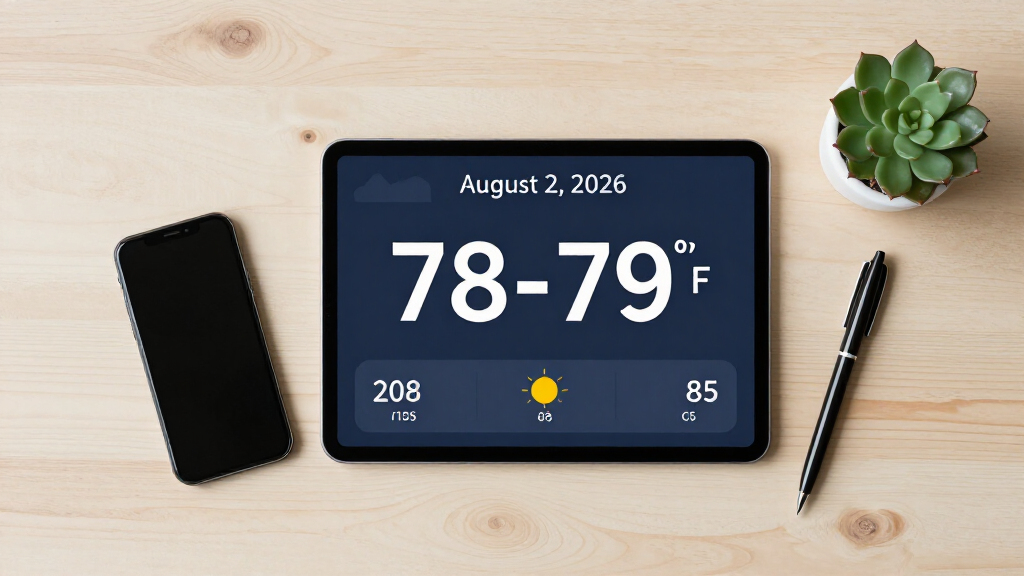
A market prediction indicates a potential maximum temperature of 78-79° on August 2, 2026. However, weather forecasts for that date remain uncertain, and no official prediction is confirmed. This development highlights the growing use of predictive markets for long-term weather expectations.
Recent activity in a predictive market suggests a possibility that the maximum temperature on August 2, 2026, could be between 78 and 79 degrees Fahrenheit. However, no official weather forecast or meteorological model currently confirms this prediction, and the date remains several years in the future. This market activity underscores the increasing use of predictive markets for long-term weather expectations, even as actual forecasts remain uncertain.

Get business pricing on office and shipping supplies
- Business-only prices and quantity discounts
- Tax-exempt purchasing
- Multiple users, one account, clear invoices
The Kalshi market, which allows participants to bet on specific future weather outcomes, has seen 147 recent trades related to whether the maximum temperature on August 2, 2026, will fall within the 78-79° range. While this indicates some market interest in this specific forecast, it does not constitute an official weather prediction from meteorological agencies.
Weather forecasts typically extend only a few days in advance, and reliable long-term forecasts for August 2026 are not yet available. The activity in the predictive market reflects traders’ expectations based on current climate trends and probabilistic models, but these are not guarantees of future weather conditions.
Experts emphasize that long-range weather predictions, especially for specific temperature ranges several years ahead, are inherently uncertain. The market’s activity is better understood as a reflection of collective expectations rather than a definitive forecast.
Why Market Predictions for Future Temperatures Matter
The active trading around a specific temperature range for August 2, 2026, highlights the growing role of predictive markets in gauging future weather conditions. These markets can influence public perception and decision-making, especially for sectors like agriculture, event planning, and infrastructure development that are sensitive to weather variability.
However, reliance on such markets should be tempered with caution, as they are not substitutes for official meteorological forecasts. The activity demonstrates both the interest in and the limitations of probabilistic predictions for long-term climate planning.
Products Worth Considering

Dell UltraSharp U4025QW 40-Inch Curved 5K2K WUHD LED Monitor

Samsung Odyssey G55C 32-Inch QHD Curved Gaming Monitor

Dell 34 Plus USB-C Curved Monitor, S3425DW, 34-Inch WQHD VA, 120Hz
As an affiliate, we earn on qualifying purchases.
Long-term Weather Forecasting and Predictive Markets
Weather forecasting traditionally relies on meteorological models that analyze atmospheric data to produce short- to medium-term predictions, usually up to 7-10 days. Beyond that, forecasts become increasingly uncertain. In recent years, predictive markets like Kalshi have gained attention for their ability to aggregate collective expectations about future events, including weather outcomes.
The recent market activity regarding August 2, 2026, is part of a broader trend where traders speculate on long-term climate conditions, driven by climate change concerns and economic interests. Despite this, the scientific community emphasizes that precise temperature predictions years in advance remain highly uncertain due to the chaotic nature of weather systems.
“Long-range weather predictions several years out are inherently uncertain. Market activity can reflect expectations but should not be mistaken for confirmed forecasts.”
— Dr. Emily Carter, Meteorologist
Uncertainties Surrounding Long-Term Temperature Predictions
Despite active trading, there is no confirmed scientific forecast for the temperature on August 2, 2026. The activity in the predictive market reflects expectations and probabilities, but actual weather conditions remain highly uncertain at this range. It is not yet clear how accurately such markets can predict specific temperature ranges several years in advance.
Next Steps for Climate and Weather Forecasting
Meteorological agencies will continue to refine long-term climate models, but precise daily temperature forecasts for 2026 are not expected until closer to the date. The market activity may serve as an indicator of collective expectations, but official forecasts will rely on updated climate data as the date approaches.
Researchers and analysts will monitor both scientific developments and market trends to better understand the evolving landscape of long-term weather prediction.
Key Questions
Can the temperature on August 2, 2026, be accurately predicted now?
No, current scientific methods do not allow for precise temperature predictions several years in advance. The market activity reflects expectations, not confirmed forecasts.
What does the Kalshi market activity tell us about future weather?
The activity indicates collective expectations and probabilistic assessments but should not be considered a reliable forecast.
Why is long-term weather prediction so uncertain?
Weather systems are chaotic and influenced by many variables, making accurate long-term predictions inherently difficult beyond a few weeks.
Will official weather forecasts be available for August 2026 before that date?
No, official forecasts are generally only reliable up to about 7-10 days in advance. Predictions for August 2026 will only be possible closer to the date.
How reliable are predictive markets for weather forecasting?
They can reflect collective expectations and probabilities but are not substitutes for scientific meteorological forecasts.
Source: kalshi