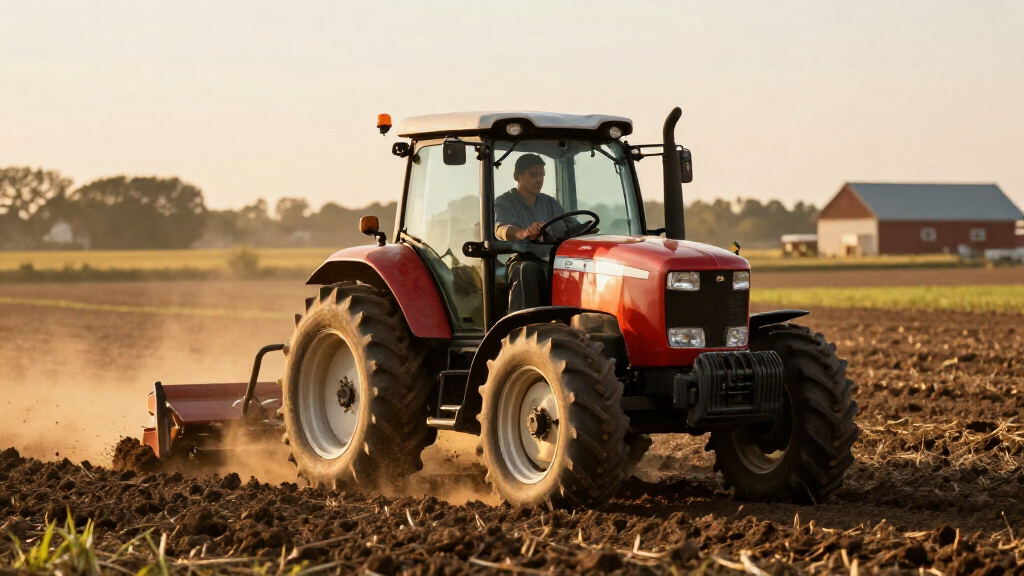

🔍 Read the full analysis: A Farm Revolution: Tractors Replace Millions Of Working Animals on ThorstenMeyerAI.com

Get business pricing on office and shipping supplies
- Business-only prices and quantity discounts
- Tax-exempt purchasing
- Multiple users, one account, clear invoices
TL;DR
A source report published November 4, 2026, describes the replacement of working horses and mules on U.S. farms by tractors over the first half of the 20th century. Their estimated number fell from 26.7 million in 1918 to 3.1 million in 1960, while farm employment also declined and agricultural output per worker rose.
U.S. farms moved from animal power to tractors over the first half of the 20th century, with the estimated number of farm horses and mules dropping from 26.7 million in 1918 to 3.1 million in 1960. A report published November 4 by ThorstenMeyerAI.com uses the shift to examine how mechanization changed farm work, land use and employment—and how far the historical analogy extends to automation today.
The figures cited in the report come from the U.S. Census Bureau’s Historical Statistics of the United States, Colonial Times to 1970, which reprints Department of Agriculture estimates. Horses alone peaked at 21.4 million in 1915; the combined count of horses and mules reached 26.7 million on January 1, 1918. By 1960, the combined count was 3.1 million, a decline of almost 90% from that peak.
Tractor numbers rose as working-animal numbers fell. The report lists about 1,000 tractors on U.S. farms in 1910, 246,000 in 1920 and 4.69 million in 1960. Around 1955, tractors first outnumbered horses and mules, according to the figures cited. The report notes that census dates varied across some tractor counts, and that the Agriculture Department began counting horses and mules together from 1951.
The shift also freed land that had been used to feed draft animals. In 1915, about 93 million acres of harvested cropland—more than a quarter of the reported total—grew feed for horses and mules. The estimate was about 5 million acres in 1960. The report also points to other farm machinery, including combines: their number rose from about 4,000 in 1920 to 1.042 million in 1960.
Mechanization Reshaped Farm Work
The change was larger than replacing one kind of power with another. Horses required land and feed throughout the year, while tractors required fuel when operated. As animals declined, acreage previously devoted to feed could be used for other crops. The report frames that land shift as a hidden dividend of mechanization, while noting that the figures describe historical estimates rather than a direct measure of the benefits to individual farms.
Farm employment contracted during the same broad period. The report cites a peak of 13.6 million U.S. farm workers in 1916 and 4.5 million in 1970, even as the overall U.S. labor force doubled. It also reports that one farm worker supplied 7.1 people in 1910 and 47.1 in 1970, using a Department of Agriculture measure that includes people abroad supplied by exports. These trends show rising agricultural output per worker alongside fewer farm jobs; they do not, by themselves, establish that tractors alone caused every job loss or the wider economic changes.
The story matters to current debates over automation because it shows that a major technology shift can change both the work performed and where people work. The report says new jobs grew in cities, requiring many people to move. It does not establish that the same outcomes will follow from modern automation: the comparison is a historical analogy, not a forecast.
Products Worth Considering

Apple iMac 27-inch Retina 5K Display (2020, 8GB RAM, 512GB SSD)

FLEXISPOT EN1 Electric Standing Desk, 60 x 24 in, Black

Canon SELPHY CP1500 Compact Photo Printer (White)
As an affiliate, we earn on qualifying purchases.
From Fordson to Modern Farm Robots
Tractors existed before World War I, but early models were heavy, expensive and better suited to large farms, according to the report. It identifies Ford’s 1917 Fordson as a turning point for wider adoption. The Henry Ford museum describes the Fordson as “the first mass-produced and inexpensive lightweight tractor”, built to serve small farmers, and says it quickly became popular in the United States. Its 100,000th tractor came off the assembly line on February 21, 1920.
Mechanization continued beyond tractors. Combines cut, threshed and cleaned grain in one pass, while corn pickers, balers and milking machines joined improvements in fertilizer and seed. The report says that in 1983 economist Wassily Leontief compared workers with horses displaced by tractors. It also notes a limit Leontief identified: horses could not vote, unlike people affected by economic and policy decisions.
Today’s agricultural automation remains more limited than the historical tractor shift might suggest. The report says John Deere introduced a 16-camera autonomy kit in February 2025 for tillage on select large tractors. It also cites China’s statement that about 74% of ploughing, sowing and harvesting was mechanized in 2023. That figure is attributed to China and refers to those named activities; it does not mean that 74% of all farm work was automated.
““The first mass-produced and inexpensive lightweight tractor.””
— The Henry Ford museum, as quoted in the report
Limits of the Horse Comparison
The historical counts document a sharp decline in farm horses and mules, but they do not give a full account of what happened to every animal or worker. The report says farmers stopped breeding replacements and the working population aged out; it does not provide a detailed breakdown of animal outcomes or the occupations and circumstances of people who left farming.
Nor does the material establish how much of the decline in farm employment resulted specifically from tractors, as opposed to combines, other machinery, changes in farming practices or broader economic forces. Modern autonomous systems are described as real but narrow in application; the report does not quantify their effect on farm employment. Its references to China and to developments in Germany and Japan do not include comparable country-by-country figures in the supplied material.
Tracking Automation’s Next Effects
The next test is whether current farm-automation tools spread beyond their stated uses, such as tillage on select large tractors, and whether they change the number or type of workers farms need. The report supplies no adoption forecast or employment estimate for these systems. Future comparisons will need clear measures of where machines are used, what tasks they perform and how those changes affect workers and production.
For the historical record, the report’s figures establish a long transition rather than a single replacement event: tractors became more numerous than horses and mules around 1955, and the animal count stood at 3.1 million by 1960. Whether automation in other industries follows a similar path remains unresolved.
Key Questions
How many working horses and mules were on U.S. farms at the peak?
The report cites a combined estimate of 26.7 million on January 1, 1918. Horses alone had reached their reported peak of 21.4 million in 1915.
When did tractors outnumber horses and mules?
According to the report’s figures, the crossover occurred around 1955, when there were about 4.35 million tractors and 4.31 million horses and mules.
What happened to the land once used to grow animal feed?
The reported estimate for cropland used to grow feed for horses and mules fell from about 93 million acres in 1915 to about 5 million in 1960. The supplied material does not break down how all of that land was used afterward.
Does the history prove that automation will eliminate human jobs?
No. The report presents the horse-to-tractor shift as an analogy, not a prediction. It documents falling farm employment during a period of mechanization, but does not attribute that entire decline to tractors or establish what modern automation will do to jobs.
Source: ThorstenMeyerAI.com