🔍 Read the full analysis: Choosing Between 10 AI Mini PCs For Local Workloads In 2027 on ThorstenMeyerAI.com

Get business pricing on office and shipping supplies
- Business-only prices and quantity discounts
- Tax-exempt purchasing
- Multiple users, one account, clear invoices
TL;DR
The lineup ranks the MINISFORUM MS-S1 MAX as its strongest all-round choice for demanding local workloads, based on its Ryzen AI Max+ 395, 64GB of memory and 2TB SSD. The GEEKOM A9 Max is presented as a more balanced high-performance option, while incomplete configuration details and differences in memory make model-by-model checks important. The source does not provide benchmark results, prices or enough detail to verify how every system performs on specific AI software.
A buyer’s guide to 10 AI mini PCs, the original analysis, ranks the MINISFORUM MS-S1 MAX as its top all-round choice for demanding local workloads, citing its Ryzen AI Max+ 395 processor, 64GB of memory and 2TB SSD. The comparison also names the GEEKOM A9 Max as a high-performance alternative, while noting that processor labels alone do not establish whether a system can run a particular local model or application.
The guide says its ranking weighs how well the listed hardware supports AI-related workloads, alongside everyday usability, storage and the balance between capability and system demands, considerations also covered in a guide to choosing between Mac hardware and cloud AI. It favors systems with clearly specified processors, memory and storage, and places less weight on AI branding alone. The source does not provide benchmark results or a standardized test of the ten systems.
In the guide’s assessment, the MS-S1 MAX is the strongest fit for heavier work, but its workstation-oriented configuration may exceed the needs of someone using occasional cloud-based AI tools, a tradeoff explored in another guide to AI mini PCs for local development workloads. The GEEKOM A9 Max, with a Ryzen AI 9 HX 470 and 32GB of memory, is positioned as a high-performance choice with a different hardware configuration. The GMKtec K17 is described as a newer, lower-power option for buyers willing to accept less memory.
The list also includes the GMKtec EVO-X2, another system with a Ryzen AI Max+ 395, but the source does not specify its memory and SSD details. It names several models with Intel Core Ultra 9 185H hardware and flags differing listed memory types among GEEKOM IT13 MAX versions. The GEEKOM A5, with a Ryzen 7 7730U and DDR4 memory, is characterized as more suitable for basic desktop use than demanding local AI tasks.
The 10 picks
- 1
 MINISFORUM MS-S1 MAX Mini AI Workstation PC, Ryzen AI Max+ 395, 64GB LPDDR5x,…View on Amazon →
- 2
 GMKtec EVO-X2 AI Mini PC with AMD Ryzen AI Max+ 395View on Amazon →
- 3
 GEEKOM A9 Max Mini PC with AMD Ryzen AI 9 HX 470, 32GB DDR5 RAM, and 2TB SSDView on Amazon →
- 4
 GEEKOM IT15 Mini PC, Intel Core Ultra 9 285H, 32GB DDR5 RAM, 1TB NVMe SSDView on Amazon →
- 5
 ACEMAGIC F5A Top AI Mini PC with AMD Ryzen AI 9 HX 470View on Amazon →
- 6
 ACEMAGIC Retro X5 Mini Gaming PC with AMD Ryzen AI 9 365, 32GB RAM and 1TB SSDView on Amazon →
- 7
 GEEKOM IT13 MAX AI Mini PC 2026, Intel Ultra 9 185H, 24GB LPDDR5, 500GB SSDView on Amazon →
- 8
 GEEKOM IT13 MAX Mini PC with Intel Core Ultra 9 185H, 24GB RAM, 512GB SSDView on Amazon →
- 9
 GMKtec K17 AI Mini PC – Intel Core Ultra 5 226V, 16GB LPDDR5X, Intel Arc 130V…View on Amazon →
- 10
 GEEKOM A5 Mini PC with AMD Ryzen 7 7730U, 16GB RAM, 500GB SSDView on Amazon →
Memory Shapes Local AI Choices
For readers choosing a compact computer for local models, the guide highlights a practical constraint: processor capability is only one part of the decision. Memory can limit which workloads are feasible, particularly when a model runs alongside a browser, development tools or creative software. The MS-S1 MAX’s listed 64GB gives it a different capacity profile from the A9 Max’s 32GB, though the source supplies no model-specific performance tests.
The comparison also draws a line between running AI on a computer and using cloud services. Someone who mainly accesses web-based assistants may not benefit from workstation-oriented hardware. Buyers considering local processing should check their software’s hardware requirements and support for the processor, graphics and acceleration frameworks before relying on a product’s AI label.
Products Worth Considering

Apple MacBook Air 15-inch with M5 chip, 32GB memory, 512GB SSD, Midnight
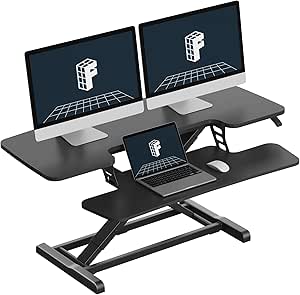
FLEXISPOT 42-Inch Height-Adjustable Standing Desk Converter with Keyboard Tray, Black

Canon SELPHY CP1500 Wireless Compact Photo Printer Bundle with Ink, Paper, and Shoulder Bag
As an affiliate, we earn on qualifying purchases.
How the Ten Models Were Ranked
The source describes a hardware-led comparison rather than a lab test: it ranks systems by the clarity and apparent suitability of their listed specifications, then considers day-to-day use, storage and memory. It says systems with incomplete configuration information rank lower because buyers have less certainty about what is included.
The guide places the A5 in the list as an everyday-computing alternative, not as a peer to the stronger AI-focused machines. It also notes that closely named versions may differ in components, including memory type. The article’s 2027 framing does not, by itself, confirm that every specification is a current retail configuration or that each model is available in every market.
“The MINISFORUM MS-S1 MAX is the “best overall pick” in the lineup.”
— ThorstenMeyerAI.com buyer’s guide
Specs and Performance Still Need Checking
The supplied source does not list all ten model names and their complete configurations in a way that supports a reliable, model-by-model specification table. In particular, it leaves the GMKtec EVO-X2’s memory and SSD details unspecified, and notes that GEEKOM IT13 MAX versions have different listed memory types. Buyers should confirm the exact configuration offered by the seller.
No prices, release dates, independent benchmarks, power measurements or tested AI applications are provided. The source also does not establish memory upgrade options, local software compatibility, or how each system handles particular models. Its rankings should be read as an editorial comparison of stated specifications, not as proof of performance across all AI workloads.
Verify the Configuration Before Buying
Before choosing, readers should identify whether their work will run locally or in the cloud, then check the target software’s processor, memory and graphics requirements. They should also confirm installed memory, whether it can be upgraded, included SSD capacity and available storage expansion for the exact product version.
A fuller comparison would need current retailer configurations, prices and repeatable workload tests. Until those details are available, the guide provides a basis for comparing listed specifications, but does not establish which machine is best for every local AI task.
Key Questions
Which mini PC does the guide rank highest?
The guide names the MINISFORUM MS-S1 MAX as its top all-round pick, citing a Ryzen AI Max+ 395, 64GB of memory and a 2TB SSD. That is the source’s assessment, not a reported benchmark result.
What makes the GEEKOM A9 Max an alternative?
The guide describes the GEEKOM A9 Max as a high-performance alternative. Its listed hardware includes a Ryzen AI 9 HX 470 and 32GB of memory, compared with 64GB listed for the MS-S1 MAX.
Does an AI-capable processor guarantee local model support?
No. The source advises checking a model or application’s hardware requirements and software support, including any driver or acceleration-framework needs. A processor name or AI label does not establish compatibility by itself.
What should buyers verify before ordering?
Confirm the exact model configuration, installed and upgradeable memory, SSD capacity and expansion options. The source flags incomplete details for the GMKtec EVO-X2 and differing memory types among GEEKOM IT13 MAX versions.
Source: ThorstenMeyerAI.com