
📊 Full opportunity report: How To Bring A Backyard ADU Project Into Focus on IdeaNavigator AI — validation score, market gap, and execution plan.

Get business pricing on office and shipping supplies
- Business-only prices and quantity discounts
- Tax-exempt purchasing
- Multiple users, one account, clear invoices
TL;DR
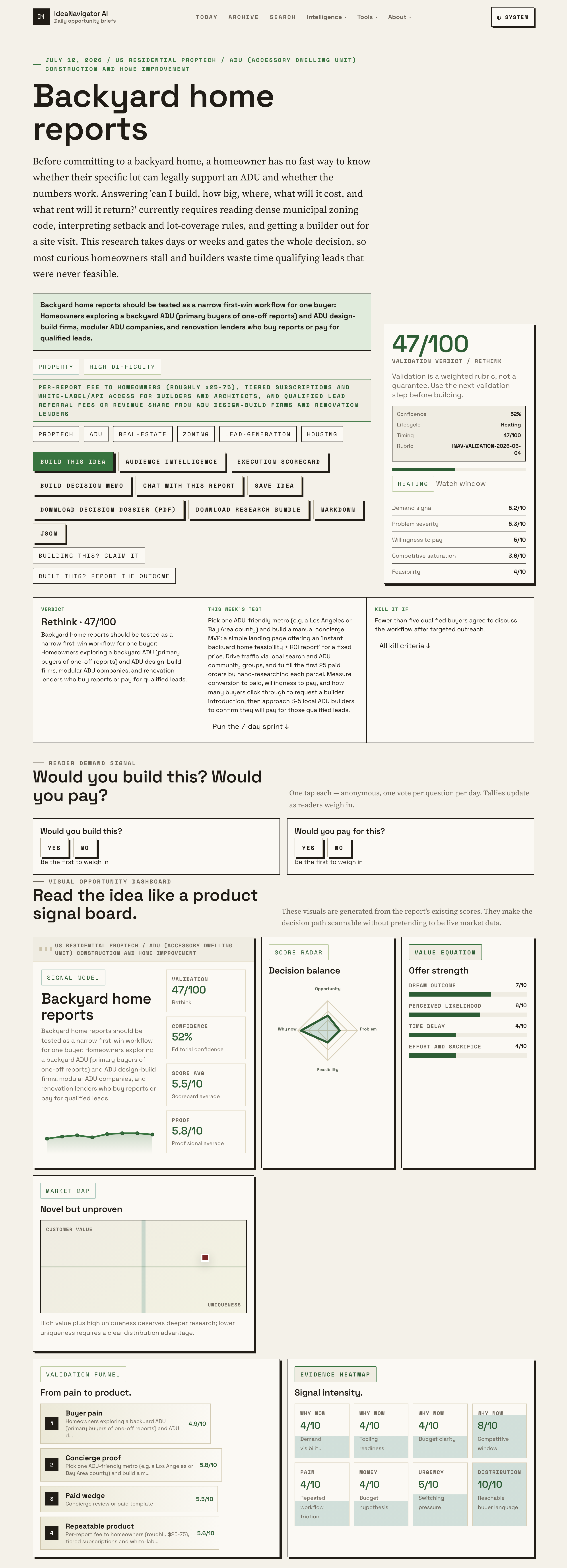
A proposed service would sell homeowners address-specific reports estimating whether a backyard ADU fits local rules and what it could cost and earn in rent. The concept remains at the validation stage: its proponents suggest manually researching the first 25 paid orders in one metro and testing whether builders will pay for qualified leads.
The proposed report would combine county parcel data, including lot boundaries, size and existing building footprint, with a locally curated set of zoning rules. For a chosen launch area, it would estimate which ADU types may be allowed, possible maximum size, setback and lot-coverage constraints, and a potential buildable area. It would also give a construction cost range and projected rent based on local comparisons.
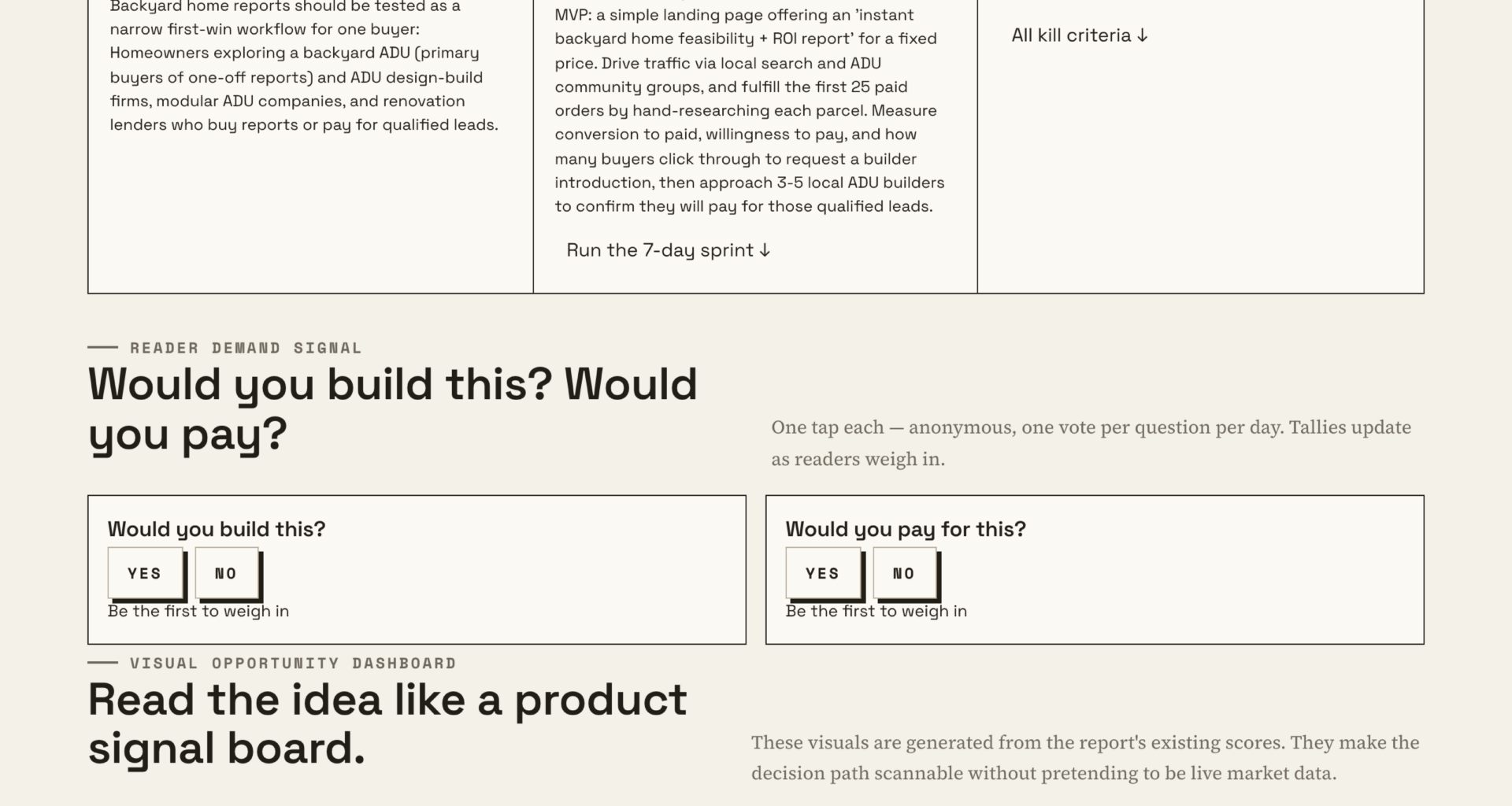
IdeaNavigator AI proposes beginning in one metro area, such as a county in Los Angeles or the Bay Area, and checking each property by hand. A simple landing page would offer the report at a fixed price; the team would fulfill its first 25 paid orders through manual research. The suggested measures are paid conversion, willingness to pay and the share of customers who ask for a builder introduction.
The proposed revenue sources include one-off homeowner reports priced at roughly $25 to $75, subscriptions or white-label and API access for builders and architects, and referral fees or revenue sharing from ADU companies and renovation lenders. These are proposed business models, not established prices or signed commercial arrangements. The plan calls for approaching three to five local builders to ask whether they would pay for leads that meet basic feasibility criteria.
A Faster First Check for Homeowners
ADU decisions can require homeowners to interpret municipal rules, review physical property constraints and arrange a site visit. The proposed report would assemble preliminary information about those factors to help homeowners assess whether to pursue further planning.
The screening could also affect builders’ sales work. If it identifies properties that do not meet criteria in a curated set of rules, companies might spend less time pursuing those inquiries. The report’s usefulness would depend on accurate local rules and property data. A preliminary estimate would not determine whether a project receives a permit or establish a final construction quote.
Top picks for "backyard project focu"
As an affiliate, we earn on qualifying purchases.
California’s ADU Expansion
IdeaNavigator AI points to California’s statewide ADU law, which took effect in 2016, and subsequent changes easing rules as reasons the idea may be timely. The proposal also cites more than 45,000 ADU permits in Los Angeles County in 2023 and says ADUs account for roughly one in five new housing units produced in California. Those figures are presented as context for the opportunity; the proposal does not provide underlying citations or define the measurement method for the statewide share.
The concept also depends on parcel and zoning data being available in usable form, alongside software that can help interpret complex rules. Its proposed approach is deliberately limited at first: hand-curate regulations for a narrow geography, then compare the estimates with the results of manual property research and customer feedback.
Pilot Results Remain Unknown
No pilot results, customer conversion figures, builder commitments or accuracy assessments are provided. It is unclear how the proposed report would handle local exceptions, conflicting records, unpermitted structures or rules that require case-specific interpretation. The suggested cost bands and rent projections also depend on assumptions that are not specified, including construction scope and the rent-comparison method.
A report could offer an initial screen, but the proposal does not establish that it could replace a jurisdiction’s permit review, professional design work or a builder’s site assessment. Whether homeowners will pay the proposed fee—and whether builders or lenders will pay for referrals—remains to be tested.
Test Demand in One Metro
The next proposed step is to choose one ADU-friendly market, publish a landing page and fulfill 25 paid orders by hand. The team would track purchases and requests for builder introductions, then speak with three to five local firms about paying for qualified leads. No launch date or results have been announced.
If customers pay and local builders show interest, the concept could inform a more automated report for that market. Expansion would still depend on checking the underlying parcel data and local rules, and on showing that estimates are useful without implying a permit guarantee.
Key Questions
Is the backyard ADU report service already available?
The proposal describes a concept and a suggested manual pilot. It does not report that a service has launched.
What would a report estimate?
It would use parcel information and a locally curated rule set to estimate possible ADU types, size and site constraints, along with a build-cost band and projected rent. These estimates would not constitute permit approval or a final construction quote.
How much might a homeowner pay?
The proposed one-off report price is roughly $25 to $75. That range is a suggested business model, not a confirmed price customers are already paying.
How would the proposal be tested?
Its proposed pilot would manually fulfill the first 25 paid orders in one metro, measure purchases and builder-introduction requests, and ask three to five local builders whether they would pay for qualified leads.
Source: IdeaNavigator AI
Fall Picks
fall essentials
As an affiliate, we earn on qualifying purchases.