

📊 Full opportunity report: A Blank Trust Tracker For Law Firms And Wealth Advisors on IdeaNavigator AI — validation score, market gap, and execution plan.

Get business pricing on office and shipping supplies
- Business-only prices and quantity discounts
- Tax-exempt purchasing
- Multiple users, one account, clear invoices
TL;DR
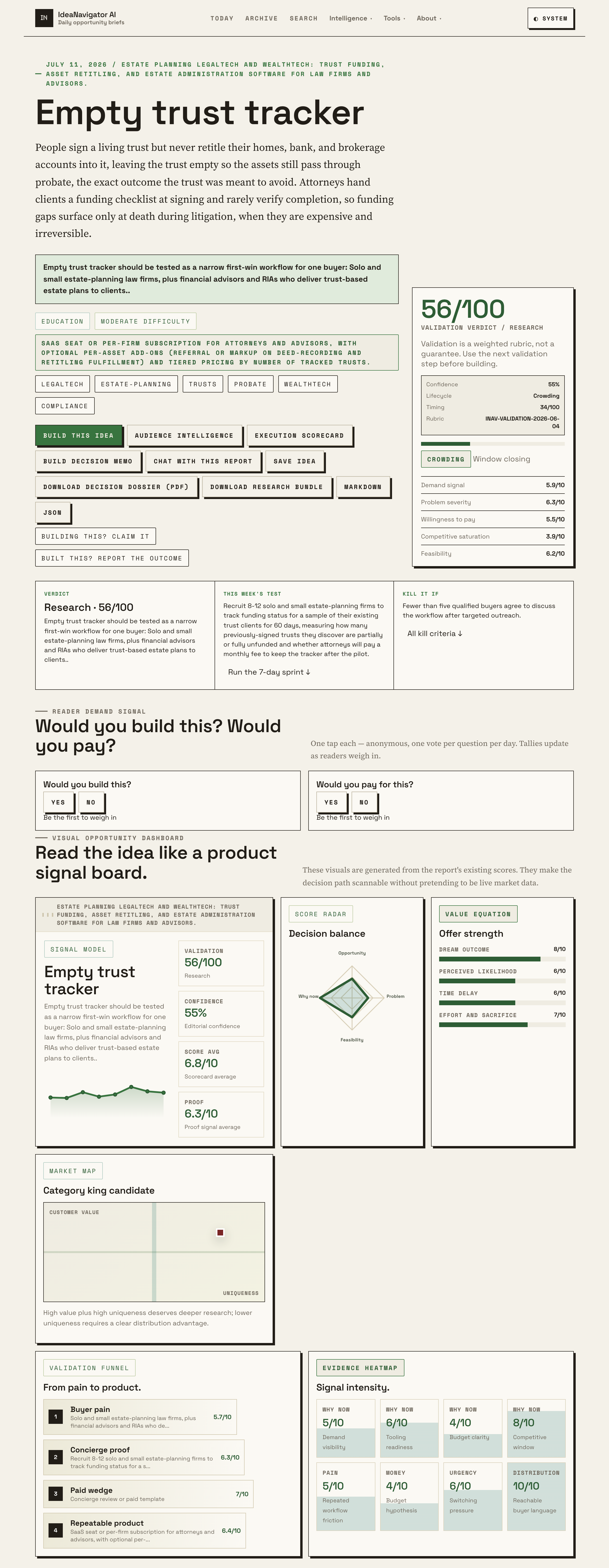
A proposed trust funding tracker would let small estate-planning law firms and wealth advisers monitor whether clients move assets into living trusts. The idea is at the validation stage: a suggested 60-day pilot with 8 to 12 firms would measure funding gaps and willingness to pay. No product launch, pilot results or customer commitments are reported.
IdeaNavigator AI’s proposal describes a client-by-client tracker to help small estate-planning law firms and wealth advisers check whether assets have been transferred into clients’ living trusts. The concept targets a funding step that can be missed after documents are signed; the proposal reports no product launch or pilot results, and suggests a 60-day test with 8 to 12 firms.
According to IdeaNavigator AI’s proposal, the tracker would let an attorney or adviser create a funding checklist for each trust, covering real estate, bank and brokerage accounts, retirement assets, business interests and beneficiary designations. Each item could be marked pending, in progress or confirmed funded, with supporting records such as a recorded deed or a statement showing an account retitled into the trust. Automated reminders would prompt clients to complete outstanding steps.
The proposal says a firm dashboard would display the funding status across its trusts, including the percentage of assets recorded as funded. That could help staff identify files with unresolved items and follow up while clients are able to act. It describes a software layer for tracking and verification; it does not say the tool would itself transfer assets, record deeds or confirm records with financial institutions.
IdeaNavigator AI suggests a subscription for a firm or per seat, tiered by the number of trusts tracked. Optional per-asset fees or revenue from referrals to deed-recording and retitling services are also proposed. These are possible pricing approaches in the proposal, not reported sales or established customer demand.
Tracking Assets After Trust Signing
A signed trust document does not, by itself, place a home or financial account into the trust. If assets are not retitled or otherwise handled as intended, they may not pass under the trust’s terms. IdeaNavigator AI’s proposal argues that a tracking system could give firms a way to identify incomplete funding during a client’s lifetime, rather than discovering a gap during estate administration or litigation.
For small practices and advisers, the potential value would depend on whether reminders and status records lead to completed transfers and save staff time. The proposed dashboard could make outstanding work visible across a firm’s client book, but the proposal provides no evidence yet of improved completion rates, reduced probate proceedings or lower costs.
The Post-Signing Funding Gap
IdeaNavigator AI says the idea is aimed at solo and small estate-planning practices, as well as financial advisers and registered investment advisers that offer trust-based estate planning. It addresses the period after a client signs a living trust, when the client may still need to change ownership records, retitle accounts or update beneficiary designations.
The proposal says about 11% of Americans hold a trust, but it provides no survey date or description of the measure. It also cites deed-funding services priced from $250 as evidence of a paid market. These figures are presented as market context in the proposal; they do not establish demand for a separate tracking subscription. The proposal says document-drafting software does not close the funding gap, but offers no product comparison or adoption data.
To test the idea, IdeaNavigator AI recommends recruiting 8 to 12 firms for a 60-day pilot and reviewing a sample of existing trust clients. The proposed measures are how many signed trusts prove partially or fully unfunded, and whether participating attorneys would pay a monthly fee to continue using the tracker.
Pilot Demand and Results Remain Unknown
IdeaNavigator AI reports no pilot, so the number of trusts with funding gaps, the rate at which clients would complete outstanding transfers and firms’ willingness to pay are unknown. The proposal does not identify a developer, launch date, existing customers or a working product.
The proposal also leaves unclear how the tracker would verify that an asset is funded, how it would handle sensitive financial documents, and whether firms would rely on uploaded proof or need confirmation from banks, brokerages or county recording offices. It does not specify how retirement accounts or beneficiary designations would be treated, which may require different steps from retitling real estate.
A 60-Day Firm Pilot Proposed
IdeaNavigator AI proposes recruiting 8 to 12 solo and small firms and tracking funding status for a sample of their existing trust clients over 60 days. The test would count previously signed trusts found to be partially or fully unfunded and ask whether attorneys would pay a monthly fee to keep using the service.
Until a pilot is conducted and its findings are shared, the tracker remains a market proposal. Evidence about client follow-through, verification methods and subscription demand would help determine whether the workflow merits a product launch.
Source: IdeaNavigator AI
Key Questions
What would the proposed trust tracker do?
It would let a law firm or adviser record funding tasks for each client trust, track their status, attach supporting documents and send reminders.
Has the tracker launched?
No launch is reported. The proposal describes a product concept and recommends a pilot.
How would the idea be tested?
The suggested test is a 60-day pilot with 8 to 12 small firms, tracking a sample of existing trust clients and measuring funding gaps and attorneys’ willingness to pay.
Would the software move assets into a trust?
The described product tracks tasks and evidence. The proposal does not say that it would execute transfers or retitle assets itself.
Source: IdeaNavigator AI
Fall Picks
fall essentials
As an affiliate, we earn on qualifying purchases.