

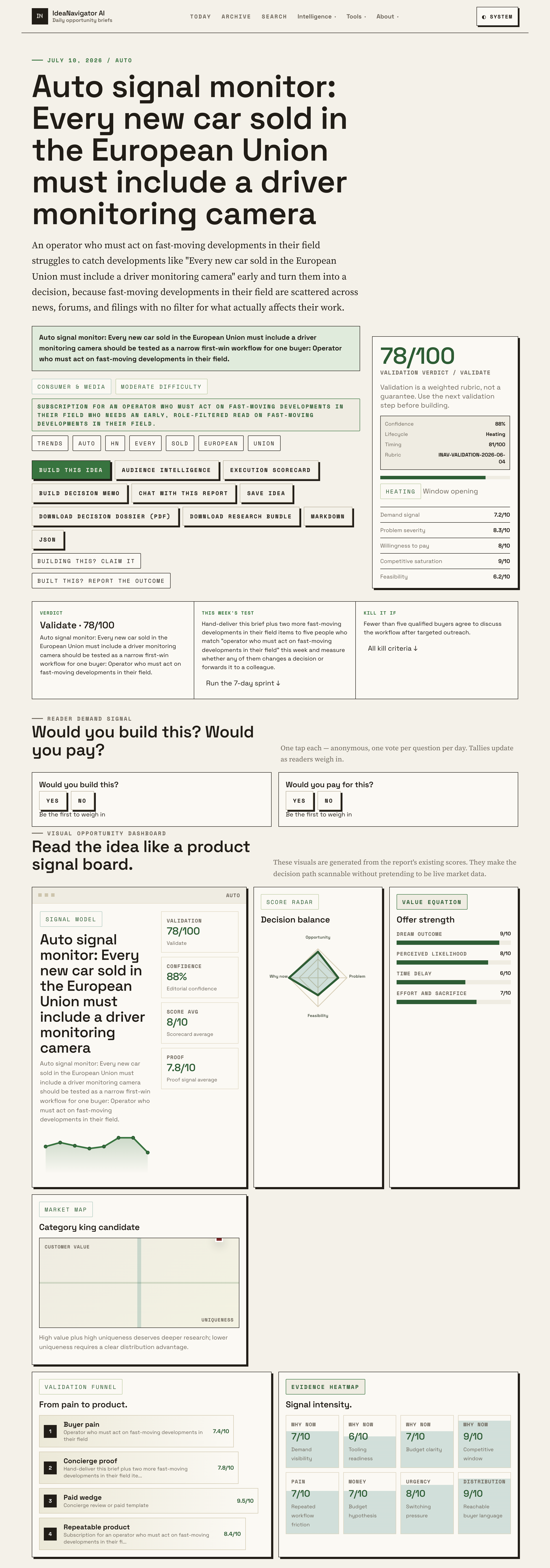
📊 Full opportunity report: Every New Car In The European Union Gets Mandatory Driver Monitoring Cameras on IdeaNavigator AI — validation score, market gap, and execution plan.

Get business pricing on office and shipping supplies
- Business-only prices and quantity discounts
- Tax-exempt purchasing
- Multiple users, one account, clear invoices
TL;DR
New cars sold in the European Union must now carry driver drowsiness and attention warning systems under the EU’s General Safety Regulation, and manufacturers are widely implementing the requirement with interior cameras. The change affects every new model sold in the bloc and raises open questions about data handling and enforcement.
Every new car sold in the European Union must now be equipped with systems that detect driver fatigue and distraction, a requirement under the EU’s General Safety Regulation that has pushed automakers to install driver monitoring cameras facing the cabin as the primary way to comply. The requirement applies to all new vehicles registered in the bloc, making interior sensing technology a standard feature rather than a premium option. The development gained renewed attention after a signal-monitoring item flagging the requirement scored 88 out of 100 on Hacker News, according to IdeaNavigator AI, highlighting how quickly operators in the automotive sector need to track such changes.
The mandate stems from Regulation (EU) 2019/2144, the EU’s General Safety Regulation, which required driver drowsiness and attention warning systems on all new vehicle types receiving type approval from July 2022, and on all new cars sold and registered from July 2024. The regulation also mandated a broader package of safety measures, including intelligent speed assistance, lane-keeping assistance, event data recorders, and emergency stop signals.
While the regulation itself specifies the outcome — the vehicle must warn the driver when it detects drowsiness or distraction — it does not prescribe the exact sensor technology. In practice, automakers have overwhelmingly adopted in-cabin cameras that track eye movement, head position, and eyelid closure, because camera-based systems perform reliably across a range of lighting conditions and driver postures compared with steering-input-only methods. Several manufacturers had already introduced camera-based attention monitoring on premium models before the mandate, and the regulation effectively made the technology universal across the EU market.
According to IdeaNavigator AI, the item was surfaced as a high-signal development for automotive-sector operators, scored at 88/100 on Hacker News, reflecting strong attention from technology and industry communities. The framing used by the signal monitor — “every new car sold in the European Union must include a driver monitoring camera” — captures the practical effect of the rule, though technically the regulation mandates the warning function rather than the camera hardware itself.
Why This Reshapes the European Car Market
The mandate matters for three groups. For consumers, it means every new EU car now carries a camera pointed at the driver’s face, a change with implications for privacy expectations inside a private space. For automakers and suppliers, it has created a large, guaranteed market for driver monitoring system hardware and software, and it effectively ended the debate over whether to make interior sensing standard. For fleets, insurers, and regulators, the systems generate new categories of data about driver behaviour, raising questions about who can access it and under what conditions.
The requirement also sets a regulatory direction that other markets watch closely. The EU has repeatedly moved first on vehicle safety and data rules, and similar driver monitoring requirements are under discussion or partial adoption in other jurisdictions, including US New Car Assessment Program evaluations that credit driver attention systems. Suppliers that build compliance-grade monitoring technology for Europe gain a template they can adapt elsewhere.
How the EU Mandate Came Into Force
The General Safety Regulation was adopted in November 2019 as part of the EU’s push to reduce road deaths toward its long-term road safety targets. It introduced a package of mandatory safety technologies in two waves: new type approvals from July 2022, and all new vehicles sold from July 2024. Driver drowsiness and attention warning was among the core requirements, alongside intelligent speed assistance, which has itself drawn criticism from some drivers over false alerts and intervention behaviour.
Before the mandate, camera-based driver monitoring was available mainly on higher-trim models from brands such as those offering semi-autonomous driving assists, where the camera verified that the driver was watching the road. The EU rule converted a feature associated with advanced driver-assistance packages into a baseline legal requirement across all price segments.
Open Questions on Privacy and Enforcement
Several things remain unclear or unsettled. First, while the warning function is mandatory, the exact share of compliant vehicles using cameras versus other sensing methods across all manufacturers is not published in a single consolidated dataset. Second, the privacy framework around the data these cameras generate — whether footage or derived attention metrics are stored, transmitted, or accessible to manufacturers, insurers, or authorities — is governed by GDPR but handled differently by each automaker, and enforcement practices are still developing. Third, it is not yet clear how national type-approval authorities will handle consumer complaints about false positives or overly intrusive system behaviour. Finally, the Hacker News signal score reported by IdeaNavigator AI measures community attention, not regulatory substance, and the discussion thread itself contains a mix of technical detail and speculation that has not been independently verified.
What Operators and Buyers Should Watch
Watch for several developments in the near term. Euro NCAP, the European consumer safety testing body, is expected to give increasing weight to driver monitoring performance in its rating protocols, which will push manufacturers beyond minimum compliance. EU regulators may issue further guidance on data retention and processing for in-cabin camera systems. For operators in the automotive sector, monitoring tools that filter regulatory developments — such as the signal-monitor workflow described by IdeaNavigator AI — are positioned as a way to catch changes like this on the day they surface rather than through delayed roundups. Buyers can expect continued debate over how to disable or limit camera-based monitoring where the law permits, and whether such disabling affects insurance terms or vehicle functionality.
Key Questions
Do all new cars in the EU really have a driver monitoring camera?
Since July 2024, all new cars sold in the EU must have drowsiness and attention warning systems. Cameras are the most common way manufacturers comply, though the regulation mandates the warning function rather than specifying camera hardware.
Can the driver monitoring camera be switched off?
Practices vary by manufacturer. Some systems allow temporary deactivation with repeated warnings, while others cannot be fully disabled because the monitoring function is tied to regulatory compliance. Details differ by brand and model, and EU rules on this are still evolving.
Does the camera record video of the driver?
In most implementations the camera processes images in real time to detect eye closure and head position without storing video. However, data handling policies differ between manufacturers, and how any stored data is treated under GDPR is an area of ongoing regulatory attention.
Do cars sold outside the EU need these cameras?
The mandate applies to vehicles sold in the European Union. Other regions, including the United States through its New Car Assessment Program, are encouraging or partially crediting driver monitoring systems, but a universal equivalent mandate does not currently exist everywhere.
Why did this development resurface as news now?
A signal-monitoring item flagging the requirement scored 88/100 on Hacker News, according to IdeaNavigator AI, drawing renewed attention to the fact that the technology is now standard on every new EU car rather than an optional feature.
Source: IdeaNavigator AI
Fall Picks
fall essentials
As an affiliate, we earn on qualifying purchases.