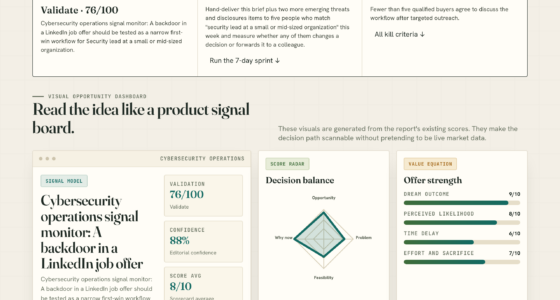

📊 Full opportunity report: The New Security Paradigm: AI At The Forefront on ThorstenMeyerAI.com — validation score, market gap, and execution plan.

Get business pricing on office and shipping supplies
- Business-only prices and quantity discounts
- Tax-exempt purchasing
- Multiple users, one account, clear invoices
TL;DR
A flaw in a hardware wallet’s firmware led to a theft of over $70 million in Bitcoin, exposing vulnerabilities in security systems. Experts suggest AI-assisted tools may have played a role in discovering or exploiting the bug, marking a shift toward AI-driven security challenges across digital assets.
On July 30, over $70 million worth of Bitcoin was stolen from nearly 1,200 wallets through a flaw in a hardware wallet’s firmware—an event that highlights the growing influence of AI in cybersecurity. The attack was carried out by exploiting a bug that had remained undetected for over five years, revealing vulnerabilities in even the most trusted security devices. This incident underscores a new phase in digital security, where AI-assisted discovery and exploitation are reshaping threat landscapes.
The breach involved a firmware update issued in March 2021 by the hardware wallet manufacturer, Coinkite, which inadvertently rerouted the device’s key generation process from a dedicated hardware random-number generator to a deterministic software fallback. This change reduced the entropy of the generated private keys from the intended 128+ bits to as little as 40 bits on older models and 72 bits on newer ones, making the keys vulnerable to brute-force attacks.
Once the flaw was understood, attackers could generate all possible private keys within the reduced entropy space offline. They then checked these keys against the blockchain to identify which held balances, prioritizing larger holdings. The script automated the process, draining over $70 million in less than an hour, with no recourse for victims due to Bitcoin’s irreversible nature. Coinkite acknowledged that this was a result of engineering error, with CEO Rodolfo Novak noting that AI-assisted code review could have helped detect the bug earlier.
While there is no public evidence that AI was directly used to find or execute the attack, experts suggest that AI tools likely played a role in the discovery, tooling, or speed of the operation, given the timing and complexity involved. The incident has sparked discussions about the increasing role of AI in both security and cyber threats.
A firmware error shrank the pool that “random” keys were drawn from. A searchable pool is a drainable one. Here is the mechanism, conceptually — no operational detail.
A March 2021 firmware update rerouted key generation from the device’s hardware random-number generator to a deterministic software fallback — drawing seeds from a dramatically smaller universe.
Once the flaw is understood, the whole attack runs on an ordinary machine — no internet needed until the final move.
Implications of AI-Driven Security Threats in Digital Assets
This incident signals a broader shift in cybersecurity, where AI is not only a tool for defense but also a catalyst for new attack methods. The ability of AI to accelerate bug discovery, automate exploitation, and adapt rapidly to defenses means that traditional security measures may be insufficient against sophisticated, AI-enabled threats. For consumers and organizations, this underscores the need to reevaluate security protocols and incorporate AI-aware strategies.
Moreover, the event highlights the importance of rigorous testing and review processes, especially as AI-assisted audits become more common. The breach demonstrates that even trusted, well-established security hardware can harbor latent vulnerabilities, which AI might uncover faster than human experts.
hardware wallet with secure firmware
As an affiliate, we earn on qualifying purchases.
As an affiliate, we earn on qualifying purchases.
The Evolution of AI’s Role in Cybersecurity and Hardware Vulnerabilities
For years, cybersecurity has relied on manual testing, code reviews, and hardware-based protections. However, recent developments show that AI tools now assist in identifying vulnerabilities faster and more comprehensively. The incident with the hardware wallet underscores how AI can be both a double-edged sword—enhancing security or enabling more efficient attacks.
The specific flaw originated from a firmware update in 2021, which shifted key generation from a hardware RNG to a deterministic software process. Despite multiple audits, the bug remained hidden until it was exploited, illustrating the limitations of human-led testing in complex AI-influenced environments. The event also reflects a broader trend: as AI models become more capable, they influence both the development of security tools and the tactics of attackers.
"This is the sober reality of a new AI paradigm, where AI-assisted code review can now surface latent bugs faster than the industry's most seasoned experts."
— Rodolfo Novak, CEO of Coinkite
AI cybersecurity tools for digital assets
As an affiliate, we earn on qualifying purchases.
As an affiliate, we earn on qualifying purchases.
Unclear Role of AI in the Attack’s Discovery and Execution
There is no direct evidence confirming AI's involvement in the specific attack, whether in discovering the bug or executing the theft. Analysts currently attribute the root cause to human engineering error, though suspicions remain that AI-assisted tools may have contributed to the speed and scale of the breach. The exact extent of AI’s role remains unconfirmed and is a subject of ongoing investigation.
As an affiliate, we earn on qualifying purchases.
Monitoring AI’s Impact on Future Security and Breach Prevention
Security experts and organizations are expected to increase AI integration into both defensive measures and vulnerability detection processes. Simultaneously, there will be heightened scrutiny of AI’s role in facilitating attacks. Future developments may include new standards for AI-assisted security audits, more robust hardware design protocols, and increased transparency around AI’s influence in cybersecurity incidents.
Additionally, industry stakeholders will likely push for improved testing and validation methods to prevent similar vulnerabilities. The incident serves as a wake-up call for the entire digital ecosystem to adapt to an AI-enhanced threat landscape.
As an affiliate, we earn on qualifying purchases.
Key Questions
Could AI have directly caused the breach?
There is no confirmed evidence that AI directly caused or executed the attack. Experts suggest AI tools may have played a role in discovering the vulnerability or speeding up the exploitation, but this remains speculative.
What can users do to protect themselves now?
Users should review and update their hardware wallets, enable multi-factor authentication where possible, and stay informed about firmware updates and security advisories from device manufacturers.
Will AI help prevent future vulnerabilities?
AI is expected to be integrated more into security protocols to detect vulnerabilities earlier. However, attackers may also leverage AI, making ongoing vigilance and improved testing essential.
Is this incident isolated or part of a broader trend?
While the specific breach involved a hardware wallet, it highlights a broader trend of AI influencing cybersecurity—both in defense and attack—signaling a fundamental shift in digital security paradigms.
Source: ThorstenMeyerAI.com
Fall Picks
fall essentials
As an affiliate, we earn on qualifying purchases.