
📊 Full opportunity report: Outcome-First Decisions: Keep, Change, or Kill on ThorstenMeyerAI.com — validation score, market gap, and execution plan.

Get business pricing on office and shipping supplies
- Business-only prices and quantity discounts
- Tax-exempt purchasing
- Multiple users, one account, clear invoices
TL;DR
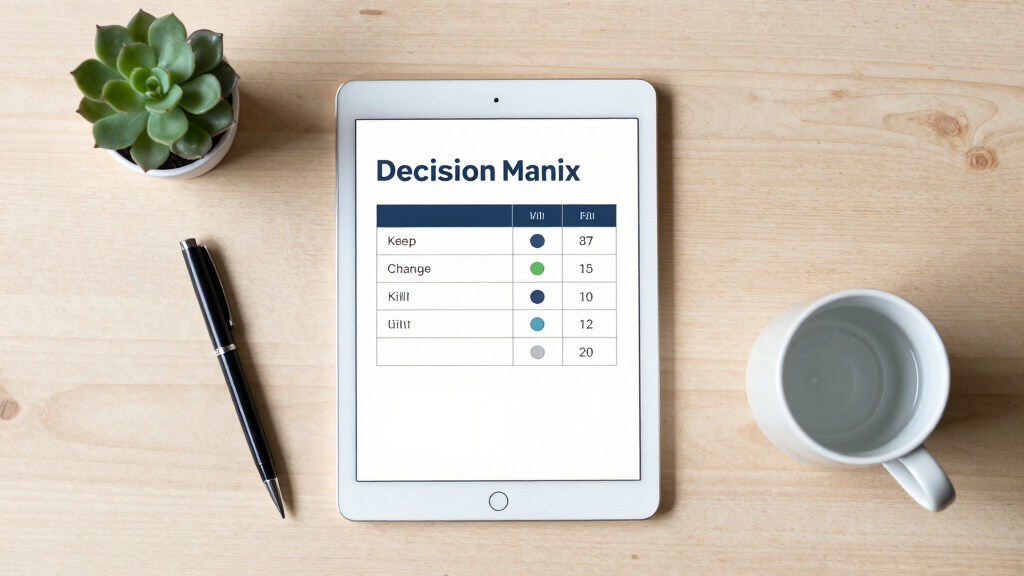
Outcome-First Decisions is a framework that guides organizations to evaluate initiatives based on current outcomes, enabling better pruning of projects. It emphasizes killing those that no longer justify their costs, promoting more efficient resource use.
A new decision-making framework called Outcome-First Decisions has been introduced, aiming to help organizations determine whether ongoing initiatives should be kept, changed, or terminated based on their current outcomes. This approach addresses the common issue of projects continuing despite diminishing returns, which can drain resources and hinder growth. You can learn more about Outcome-First Decisions and how it guides organizations.
The Outcome-First Decisions framework evaluates each initiative by asking a single, outcome-focused question: is the current result worth its ongoing cost? It returns one of three verdicts: keep, change, or kill. The process is driven by the Worth Filter, which emphasizes forward-looking judgment rather than past investments or effort.
Developed by Thorsten Meyer, the framework is designed to be provider-agnostic, running on local compute, and is open source under the AGPL-3.0 license. It aims to serve as a final decision node in portfolio management, closing the loop of idea generation, planning, and review, by routinely pruning underperforming initiatives.
While the framework promotes easier killing of initiatives that no longer justify their costs, it also emphasizes the importance of careful outcome measurement to avoid misjudgments. Critics warn that outcomes can be gamed and that emotional or subjective factors may still influence decisions despite the framework’s objectivity.
Outcome-First Decisions — keep, change, or kill
The hardest decision isn’t what to start — it’s what to stop. Judge every initiative by the outcome it produces now, not the effort already spent.
Independent commentary, produced with AI assistance under human editorial oversight. The views are the author’s own and may change. Outcome-First Decisions is open source under AGPL-3.0, provided “as is” without warranty; see the repository LICENSE. The framework’s verdicts are reasoning aids based on the inputs given and may be wrong — decision support, not decisions; verify independently before acting. Product and company names are trademarks of their respective owners; mention does not imply endorsement.
Implications for Organizational Portfolio Management
This framework offers organizations a disciplined approach to resource allocation by systematically identifying and ending initiatives that no longer produce valuable outcomes. It aims to reduce waste, free up capacity, and improve overall efficiency by promoting routine pruning of underperforming projects. The emphasis on outcome-based judgment could shift organizational culture toward more honest and data-driven decision-making, but it also raises questions about measurement accuracy and emotional resistance to killing projects.As an affiliate, we earn on qualifying purchases.
The Challenge of Portfolio Overgrowth
Many organizations struggle with maintaining a healthy balance of ongoing initiatives, often continuing projects due to sunk costs, identity, or effort justification. This leads to a long tail of underperforming or dead projects that consume attention and resources without delivering value. The need for a systematic approach to stopping initiatives has been recognized as critical for effective portfolio management. The Outcome-First framework builds on existing ideas about pruning and emphasizes outcome-focused evaluation as a solution.“The hardest decision in any portfolio isn’t what to start. It’s what to stop.”
— Thorsten Meyer
As an affiliate, we earn on qualifying purchases.
Limitations of Outcome Measurement and Emotional Resistance
It remains unclear how effectively the framework can prevent misjudgments caused by inaccurate outcome measurement or gaming. Critics warn that outcome metrics can be manipulated, leading to premature killing or keeping projects that are actually valuable. Additionally, emotional resistance within organizations may still hinder decisive action, even with the framework’s objective design.
As an affiliate, we earn on qualifying purchases.
Implementation and Adoption Challenges
Organizations interested in this framework may begin pilot testing it within specific portfolios. Further development could include refining outcome metrics and integrating the framework into existing decision processes. Broader adoption will depend on how well organizations can adapt their measurement practices and overcome emotional barriers to stopping initiatives.
As an affiliate, we earn on qualifying purchases.
Key Questions
How does the Outcome-First framework differ from traditional project evaluation?
It emphasizes judging initiatives based on current outcomes and ongoing costs, rather than past investments or effort, making stopping decisions more rational and forward-looking.
Can this framework help prevent organizations from prematurely killing valuable projects?
While it promotes careful outcome measurement, critics note that slow-start projects may be misjudged as failures, so judgment still depends on accurate metrics and context.
Is the framework suitable for all types of organizations?
It is designed to be provider-agnostic and flexible, but its effectiveness depends on the organization’s ability to measure outcomes objectively and resist emotional biases.
What are the main risks of adopting Outcome-First Decisions?
Risks include mismeasurement of outcomes, gaming metrics, and emotional resistance, which could lead to inappropriate killing or keeping of initiatives.
Source: ThorstenMeyerAI.com
Fall Picks
fall essentials
As an affiliate, we earn on qualifying purchases.